Origins, Geography, and Early Human Use of the Ohio River
The Ohio River is the Mississippi River’s most significant tributary by volume. According to McNeese (2004), the Ohio River was created by glaciers in the Ohio Valley. Consecutive glaciers shaped the Ohio Valley’s morphology as they drifted and altered, forming low-lying mountains and river valleys. The Allegheny and Monongahela Rivers, two of the earliest tributaries of the Ohio River, were formed by the same glaciers that produced the river courses. Even though geological changes in the Ohio Valley would continue for hundreds of years, the modern-day Monongahela’s general path had already been defined.
In Pittsburgh, Pennsylvania, the Monongahela and Allegheny Rivers converge to form the Ohio River. Before emptying into the Mississippi River near Cairo, Illinois, the river travels about 900 miles southwest (McNeese, 2004). People who have lived along the banks of the river fished, harvested its wealth of resources, and used it as a key transit route across North America’s interior (Galvin, 2000). More than 5,000 miles of significant river channels, such as the Muskingum, Kentucky, Hocking, Scioto, Licking, Great Miami, Wabash, Cumberland, Green, and Tennessee Rivers, supply the Ohio River (McNeese, 2004).
The Ohio River had a significant impact on the expansion of trade in America. Most of the first white settlers from the British colonies along the Atlantic coast traveled to the Ohio region across the Appalachian Mountains (Galvin, 2000). The Ohio River served as the boundary between the free states of the American Union and the slave-owning states of the American South.
Natural Hazards Along the Ohio River
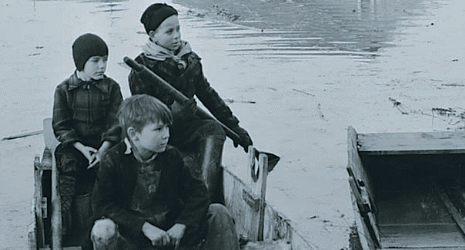
Flooding has been a persistent issue along the Ohio River’s course and is one of the region’s most significant hazards. The 1937 flooding was one of the most significant in the river’s history, causing massive destruction and loss of life (McNeese, 2004). Floodwaters overwhelmed towns and settlements along the river, causing widespread damage to structures, facilities, and agricultural land. The flood also greatly impacted navigation, making it impossible for boats to traverse the river.
There were inherent dangers and natural obstacles to sailing along the river. As a result of the river’s shallowness, the Falls of the Ohio, located close to Louisville, Kentucky, presented a significant navigational challenge. To facilitate navigation, “planters and sawyers” were to be removed from the Ohio River’s central channel by the Corps of Engineers.
Significance of the River in the Civil War
The Ohio River was crucial during the American Civil War, which lasted from 1861 to 1865. The river was a crucial military and supply transit route, functioning as a border between the Southern and Northern states. West of the Appalachian Mountains, the Union forces used the Ohio River as their primary supply and transportation route (McNeese, 2004). Its cities served as distribution centers and storage facilities for ammunition and supplies, and its boatyards constructed gunboats. The Underground Railroad, a system of covert routes and safe homes used by enslaved people to flee to freedom in the North, included the river as a crucial element.
To assist enslaved individuals across the river and find freedom in the North, numerous Underground Railroad operators endangered their lives. Kentucky, one of the slave states that chose to stay neutral in the conflict, saw action in several conflicts close to the Ohio River (McNeese, 2004). One Confederate officer who fought in the region was Officer Kirby Smith, who captured Lexington, Kentucky, and established a pro-southern Kentucky government (McNeese, 2004). The Ohio River area saw multiple Confederate military movements considering its strategic relevance, but no significant battles occurred. The river, nevertheless, was essential to the Union’s success because it made it possible to convey military personnel and supplies to the battle lines.
Significance of the River in the American Revolution
The Ohio River’s contribution to the military effort throughout the American Revolution was substantial. For both the American and British armies, along with the Native American communities who were engaged in the fight, the river was a crucial transit route (McNeese, 2004). During the American Revolution, the Ohio River Valley was a fiercely disputed territory, with American and British soldiers striving for control. The Americans wanted to block British supply routes and take control of the area, while the British aimed to utilize the Ohio River to support their forces in the west.
George Rogers Clark was in charge of one of the most critical military operations of the American Revolution in the Ohio River Valley. To win the Revolutionary War, Clark’s strategy weakened British supremacy throughout the border (McNeese, 2004). In addition to influencing the course of the history of the Ohio River, Clark’s war accomplishments enabled the United States to defend the area.
Later, Clark established Louisville, Kentucky, one of the most significant Ohio River cities (McNeese, 2004). Ultimately, the Ohio River was an essential part of the American Revolution, acting as a conduit for supplies and troops and a battleground between the American and British armies. The role played by the river in the war struggle had an impact on both regional and national history.
References
Galvin, P. (2000). Piracy on the River Ohio: Cave-in-Rock.
McNeese, T. (2004). The Ohio River. Rivers in American Life & Times. United States: Infobase Holdings, Incorporated.