Introduction
This paper utilizes a towing ship to conduct aerodynamic tests, verifying values and determining relationships between variables. A mandatory component of such an analysis is to perform mathematical calculations. This report focuses on performing such calculations that can answer questions about the nature of the relationship between speed and time, as well as evaluating other characteristics of the simulation.
Experimental Procedure
Among all five tests of the Rough Hull ship, the second one was chosen because it offered the most informative data with minimal errors. The speed and time data were downloaded into Excel and then subjected to statistical analysis. The report below examines the various characteristics of the simulation process in sequence and shows the calculations.
Dependence of Velocity on Time
The first part of the report examines the dependence of the velocity function on time. Recall that water velocity was measured automatically and recorded in a spreadsheet, so the final number of points was large. In particular, the results of the second test, which were selected and processed for analysis, are plotted in Figure 1. On the ordinate axis, the velocity values are measured, and the abscissa axis represents the time scale. The relationship between the variables is not linear.

Over time, the velocity changed from an ascending linear trend to a horizontal line, which means that it remained virtually unchanged. The regression equation describes the behavior of velocity over time, and this equation represents the best-fit line. The value of the coefficient of determination, R², indicates that this model explains 99.49% of the variance in velocity.
Taking the derivative of this function helps determine the mathematical expression for the acceleration function. Strictly speaking, acceleration is the change in velocity per unit time. If acceleration turns out to be a positive value, then the ship is accelerating, that is, gradually increasing speed (Albert, 2022). In contrast, if acceleration is negative, the object slows down; that is, subsequent velocities are less than the previous velocities. If acceleration were zero, however, the object moved uniformly, without a change in its velocity. Generalizing these conclusions based on the representation in Figure 1, we can conclude that the object’s acceleration would be positive until approximately the 8th second, and then it would become almost zero. To obtain a mathematical notation for the acceleration, it is necessary to obtain the derivative function:


The previous conclusions can be checked to estimate the accelerations at different points in the function. For example, at the point t = 2 sec., the acceleration was:

The acceleration was greater than zero, as expected, since the velocity gradually increased. In contrast, it is expected that at the point t = 12 sec., the acceleration could be zero, since the velocity did not change much:

It turned out to be practical, and the deviation from zero is due to the non-ideal behavior of the velocity function. If we integrate this function with respect to the time variable, we obtain an expression for the traveled distance function. The limits of integration in such an integral are the time values of the test, that is, from zero to 14.62 seconds. It is worth noting that the answer calculated during such integration may not be completely accurate, since the values have been rounded:

That is, in the past 14.62 seconds, the ship traveled a distance of 10.47 meters. It is worth clarifying that in each of the five tests for the ships, which were pulled behind the leading edge, the total time of the investigation was about the same, and the applied effort turned out to be identical. So, we can conclude that the ship went about the same distance in each of the trials. The errors leading to discrepancies in distance or deviations were due to measurement errors and uncertainties.
Regression Analysis
In this section of the report, we performed a manual regression analysis on the speed and towing resistance data. The data collected from the five tests are shown in Table 1:

The green area of this table shows the results, not the measurements, but the calculations; these values are needed to calculate the key components of the regression analysis. These include the gradient and y-intercept in the regression model equation, as well as Pearson correlation and determination coefficients. The regression equation looks as follows:

That is, it is linear. If the gradient turns out to be positive, then, along with the growth of velocity, there is a corresponding increase in the variable R/V. Calculating the gradient is quite simple:

Then it is also easy to calculate the value of the y-intercept, where the argument of the function is zero, if we take the point (1.230, 0.93):


Then the general regression equation is as follows:

For this equation, which describes the behavior of the function R/V (V), the gradient turned out to be positive, indicating an increase in R/V with increasing velocity. At the same time, the y-intercept determines the value of R/V at zero velocity. Under ideal conditions, this should be zero. However, in our case, the nonzero y-intercept is the result of approximation due to the regression model. We can also find values for the Pearson correlation coefficient:
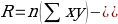
That is, there is a strong positive relationship between the two numerical variables, which means that as one of them grows, there is indeed an increase in the other. From the Pearson correlation, we can calculate the coefficient of determination:

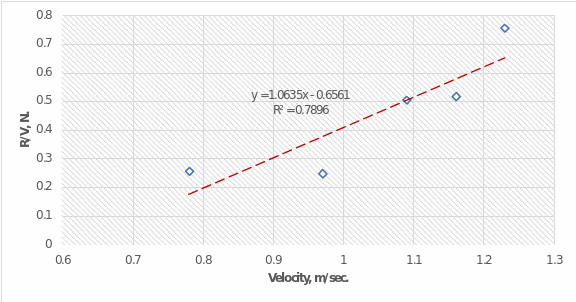
Therefore, the constructed regression model accounts for 78.6% of the variance in the dataset. Although the calculations were done correctly, there may be some bias caused by forced rounding. If rounding had not been done, the calculations would have been much more cumbersome. Alternatively, we should compare the values obtained with the automatic Excel calculations. Figure 2 shows the regression equation: it is more accurate because Excel does not round the values as much (Cote, 2021). As can be seen, the exact gradient is slightly larger than the calculated gradient, whereas the exact y-intercept is smaller.
This difference between the y-intercepts is clearly visible in the graph in Figure 2; the point (1.230, 0.93) does not lie on the regression line, indicating the presence of outliers. The coefficients of determination appear to be practically identical. Thus, we can conclude that the calculated regression equation generally corresponds well to the exact model from Excel.
SNR Analysis
When dealing with signal transmission in telecommunications, the obvious need is to improve the purity of the signal. When the internet or cellular service is poor, users are faced with long wait times and errors. To check signal purity, we can use the SNR parameter, which literally corresponds to the ratio of the average signal value to the standard deviation (Cadence PCB, 2021). The higher this value, the more ideal the signal is for data transmission. In this work, the signal can be evaluated using the fifteen points from Figure 1 for which the rate appears to be as high as possible. These selected points are shown in Table 2.

For them, it is necessary to find the average value:

It is also necessary to calculate the standard deviation:

That is, all values in this sample deviate on average by 0.02 from the average value of 0.94 m/s. Then the SNR is equal to:
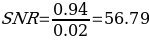
This is a very good rating, indicating high signal purity. That is, all the velocity points were close to each other and did not scatter much. So, in telecommunications, such a signal can be used for reliable data transmission.
Solution of the Case Study
In this final part of the report, as an assignment, we had to analyze a given distance function for the ship. The difference between this function and the one proposed above is that the distance function is cubic, and there is a polynomial of the fourth degree:

For this function, we can find the derivative to estimate the expression for the velocity:

The function is zero when the velocity is zero:

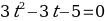
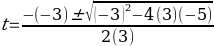



A negative value of time makes no physical sense, so we can say that the velocity turns to zero at a time of 1.88 seconds. At that, after six seconds, the velocity is:

This function can also be differentiated to find the acceleration:

Then the acceleration is zero after:


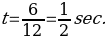
And after four seconds, the acceleration is:

Finally, after ten seconds, the ship will have traveled a distance equal to:



Conclusion
The report investigated modeling issues for towing a ship. It was found that the water velocity is not linearly dependent on time but is described by a polynomial function. The calculated regression equation was not significantly different from the exact expression in Excel, confirming a linear relationship with a high positive correlation between R/V and V. In addition, the SNR signal for the velocity data was quite high.
Reference List
Albert (2022). Acceleration: explanation, review, and examples.
Cadence PCB (2021). What is the Signal-to-Noise Ratio and how to calculate it?
Cote, C. (2021). What is regression analysis in business analytics?