Objectives
To investigate, detect, and rectify the error signal in a closed-loop position controller.
Background
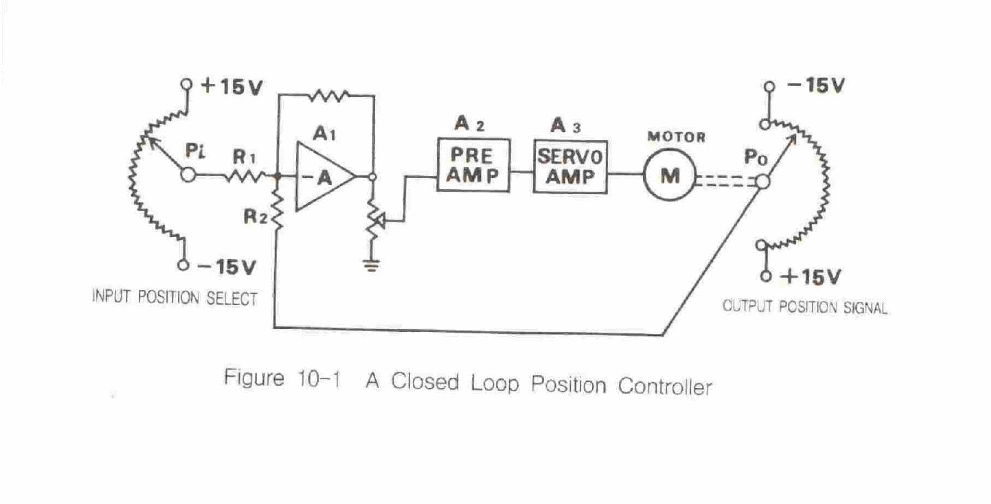
In a closed-loop position control system, the positional information from an output potentiometer (Po) connected to a motor is sent back to a control amplifier. The reference position input from an input potentiometer (Pi) is then combined with the feedback signal at the input of the amplifier (Siddiqui et al., 2020). This combined signal drives the motor in proportion to the difference between the two signals (Kaya, 2020). When the two positions are the same, the output of the amplifier becomes zero. Figure 2 displays a simplified systematic diagram of the closed-loop position controller that will be utilized in this experiment.
Apparatus
- U-151 Dual attenuator
- U-152 Summing amplifier
- U-153 Pre-amplifier (gain: 20 dB)
- U-154 Motor driver amplifier (10 Watts)
- U-156 DC power supply
- U-157 Potentiometer
- U-158 Potentiometer
- U-161 (Motor: 12V, 4.5W | Tacho generator: Approx. 3Vp-p/4000RPM)
- Voltmeter
- Patch chords
Block Diagram
The following block diagram illustrates the closed-loop system. The fundamental components of a closed-loop control system comprise an error detector, controller, feedback elements, and power plant.

Schematic Diagram
Procedure
According to the diagram above (see Figure 1), the modules were arranged and connected, including the coupling of U-158 to U-161. The U-152 switch was set to “a” and U-151 to “10”. The power of U-156 was turned on, and the U-157 dial was set to 180 degrees.
U-153 was adjusted to make the output of U-154 zero, and once the adjustment was done, the setting of U-153 was not altered. U-151 was set to “9”. Within 20 degrees from the original 180-degree setting, U-157 was turned clockwise and observed if U-158 followed the movement. U-158’s motion was expected to lag behind U-157’s.
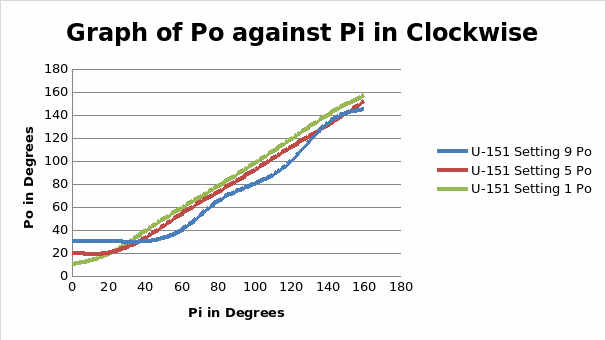
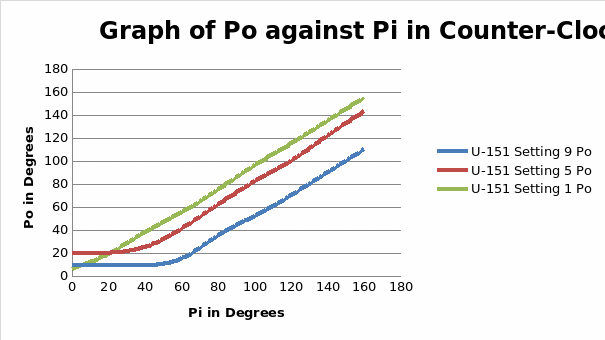
Since U-158 led U-157, the wires of the U-161 motor were switched. U-157 was turned clockwise from 0-degree position by 20-degree increments up to 160 degrees, and the angle of U-158 was measured at each position of U-157. The measurements were repeated with U-157 turned counter-clockwise, and the offset error angle between U-157 and U-158 was calculated at each position.
The system gain was increased by setting U-151 to 5 and 1. At each U-151 setting, the Step 5 experiment was repeated, and the change in offset error angle was observed as a function of the system gain. The results of Steps 5 and 6 were plotted, and all three setting curves (9, 5, and 1) were plotted on the same graph for comparison.
Measurements
Table 1: Clockwise measurements
Table 2: Counter-clockwise measurements
Graphs
Term Definitions
System Gain
The term “system gain” pertains to the proportion of the alteration in the output of a given system to the alteration in the input. Within the framework of a closed-loop position controller, the gain coefficient ascertains the magnitude of the alteration in the output or position of the controller in reaction to variations in the input or set-point. A greater system gain yields a controller with heightened responsiveness, enabling rapid alignment with the reference position (see Figure 3). However, excessive gain may result in overshooting and oscillations (see Figure 4). Conversely, a decrease in system gain yields a diminished response rate and reduced overshoot, albeit potentially compromising the system’s ability to achieve precise positioning in accordance with the reference.
Dead-Band
The term “dead-band” pertains to a specific interval of input values near the established set-point, where the controller remains unresponsive. Often, this technique is employed to avert minor and inconsequential modifications in the reference from eliciting superfluous alterations in the outcome. Increasing the dead-band parameter provides greater leeway around the desired set-point and diminishes the controller’s responsiveness to minor deviations in the reference signal. However, this adjustment may also lead to a more substantial offset error.
Offset Error
The offset error refers to the discrepancy between the predetermined set-point and the real output of the controller in situations where the input remains constant. The phenomenon’s occurrence can be attributed to many factors, including but not limited to inaccuracies in the sensors, frictional forces within the system, and nonlinearity in the system’s behavior. An offset error may cause a consistent deviation between the actual position of the system and the desired set-point, which can result in a steady-state error.
Findings
The experimental results indicate that increased system gain expedites controller response, leading to a more rapid convergence towards the set point. Nevertheless, it also augments the probability of overshoot and oscillations. Conversely, reducing the system gain yields a decelerated response characterized by reduced overshoot, potentially leading to a greater offset error and delayed attainment of the set point.
It has been observed that modifying the dead-band parameter can potentially affect the controller’s responsiveness to minor variations in the reference signal. Increasing the dead-band of a controller decreases its responsiveness to minor adjustments; however, it may lead to a greater deviation from the desired set-point and a delayed reaction to significant changes in the reference signal. Reducing the dead-band size enhances the controller’s responsiveness to minor alterations, yet it may also lead to more frequent modifications and a higher likelihood of overshooting. The minimization of offset error can be achieved through meticulous calibration of sensors, mitigation of system friction, and resolution of any non-linearities. Nonetheless, its complete elimination may not be feasible, thereby potentially impacting the precision of the closed-loop position controller.
Reference List
Alam, J. et al. (2023) Control engineering theory and application. Florida: CRC Press.
Bolton, W. (2021) Instrumentation and control systems. 3rd edn. Oxford: Newnes.
Kaya, I. (2020) ‘Integral-proportional derivative tuning for optimal closed loop responses to control integrating processes with inverse response’, Transactions of the Institute of Measurement and Control, 42(16), pp. 3123-3134.
Nise, N.S. (2020) Control systems engineering. 8th edn. California: Wiley.
Siddiqui, M.A. et al. (2020) ‘Closed-loop tuning of cascade controllers based on set-point experiment’, Journal of Engineering Research, 8(4), pp. 117-138.