Background
Existing Arrangements
The existing arrangements involve the food manufacturing company consuming 40 MWh of electrical energy and 90 MWh of thermal energy per year. The company has an anaerobic digestion system installed, which produces biogas used as a fuel source for the proposed Combined Heat and Power (CHP) system.
Project Activities
The project activities involve the purchase and installation of the CHP system, as well as the annual operation and maintenance costs associated with it. The company has set aside a budget of £35,000 for the installation and an additional £17,000 for installation, operation, and maintenance costs.
Stakeholders Affected
The following stakeholders will be impacted by the implementation of a CHP system: The firm will be the principal beneficiary of the CHP system’s installation. The industrial estate in which the food production company is located will also benefit from the installation of the system. Its construction will also help the residential neighborhood by reducing the quantity of pollutants produced during the manufacturing process. The installation of the CHP system will also benefit the suppliers and installers of the system, as it will serve as a source of tax revenue for the government.
Benefits and Risks
The benefits of the CHP system include reduced energy consumption, cost savings, and reduced environmental impact. The system also has the potential to produce total system efficiencies of 60- 80% depending on the technology. The risks associated with installing the CHP system include technical risks, such as system failure due to inadequate maintenance, and financial risks, including the inability to recover the investment cost within the desired 5-year period.
Technical Review
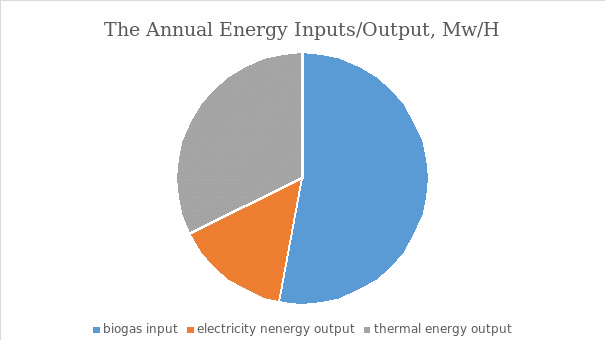
The figure above illustrates the energy inputs and outputs associated with a CHP system. These systems are energy-efficient and cost-effective solutions for providing a reliable energy supply. They combine the production of electricity and thermal energy from a single fuel, such as natural gas, and are typically used in industrial or commercial settings.
Figure 1 illustrates that the proportion of biogas input to the system is significantly greater than the output. Biogas is a renewable energy source produced by the decomposition of organic matter, including agricultural waste, sewage, and food waste. Biogas is an attractive energy source due to its low emissions and ability to be stored and used as needed.
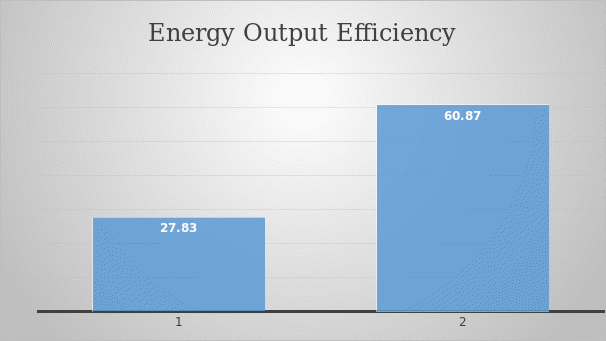
Figure 2 results indicate that the efficiency of the output is 82.9%, which means that 82.9% of the energy input is converted into useful energy output. The efficiency of the electricity output is 27.9% and the efficiency of the thermal energy output is 60.9%. In other words, 27.9% of the energy input is converted into electricity output, and 60.9% is converted into thermal energy output.
The energy conversion efficiency is never 100% due to the inherent losses associated with the energy conversion process. These losses can include energy losses due to friction, heat, and other forms of energy dissipation. Energy is also lost due to inefficiencies in the conversion process, such as incomplete combustion, electrical resistance, and other factors. Therefore, it is impossible to achieve 100% efficiency of energy conversion.
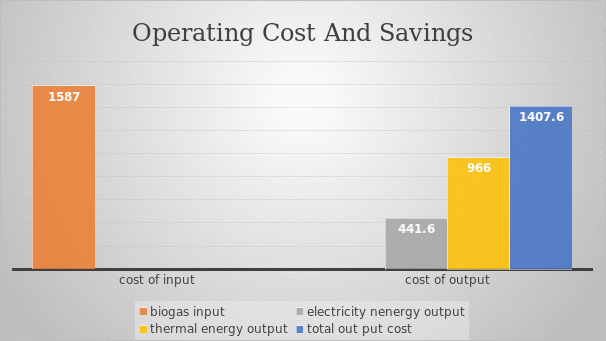
The figure below illustrates that a Combined Heat and Power plant is an efficient and cost-effective method for producing electricity. According to the estimate, it generates 158.7 MWh of energy from biogas at the cost of £10/MWh, for a total input energy cost of £1,587. The plant then generates 44.16 MWh of electricity and 96.6 MWh of thermal energy, totaling £ 1,407.6 in output energy value. When utilizing the CHP plant, this results in £179.4 savings.
CHP facilities create energy efficiently and cost-effectively. The plant is often driven by fuel, such as biogas, which is burnt to create electricity. A CHP plant’s efficiency is substantially better than that of typical power plants because the heat generated by the combustion process is collected and utilized rather than lost. This implies that more energy is generated for the same quantity of fuel.
To summarize, the computation above demonstrates that utilizing a CHP plant to generate electricity is an efficient and cost-effective option. For a total input energy cost of £1,587, it produces 158.7 MWh of energy from biogas at the cost of £10/MWh (See Figure 3). These plants are gaining popularity because they are more efficient than conventional power plants and may lower energy costs, making them an appealing alternative for organizations seeking to reduce energy expenditures.
Financial Viability
Financial viability refers to a project’s ability to generate sufficient returns to cover its costs. The financial viability of the CHP plant project can be assessed by looking at the cash flow and evaluating the return on investment (ROI). The project’s cash flow indicates an initial cost of £52,000, with annual operations and maintenance costs of £1,500.
The savings from using the CHP plant are estimated to be £179.4 per year. This means that the project’s annual net cost is £1,320.60. The total net cost of the project over the first year is £1,320.6, while the initial cost is £52,000. This means that the return on investment for the first year is 2.54%. This relatively low return does not provide much incentive for investing in the project.
The ROI for the project can be improved by increasing the savings achieved through the use of the CHP plant. This could be achieved by increasing the plant’s efficiency or by utilizing it for a broader range of applications. Alternatively, the project’s cost could be reduced by finding more affordable energy sources or by utilizing government subsidies or grants.
The payback period is the amount of time it takes for the project’s initial cost to be recovered through savings (Dachs, 2020). Based on the estimated savings, the payback period for the CHP plant project is estimated to be 28.98 years. This indicates a relatively long payback period, suggesting that the project may not be financially viable.
To determine the project’s financial viability, both the Net Present Value (NPV) and the Internal Rate of Return (IRR) were calculated. The NPV, representing the sum of all discounted cash flows over the project’s lifespan, was found to be £50,722, utilizing a 5% discount rate against the initial cost of £52,000 and a Year 1 cash flow of £1,320.60. The IRR, which conceptually represents the maximum discount rate at which the project breaks even (i.e., where NPV equals zero), was established at 18.25% using the same investment and cash flow figures.
The risk assessment of the project’s financial and economic viability can be determined by evaluating the risks associated with investing in the project and operating it. The risk of investing in the project is assessed by looking at the financial metrics used to measure the project’s financial performance, such as NPV and IRR. If the NPV and IRR of the project are positive, then the investment is considered financially viable. The risk of operating the project is evaluated by examining the operational risks associated with it, such as the availability of raw materials, labour, and the reliability of the infrastructure. If these risks are manageable, the project is considered operationally viable.
Economic, Energy, and Environmental Benefits
There are various financial advantages to building a CHP plant. One of the most notable advantages is the decrease in energy expenditures resulting from the production of both electrical and thermal energy from the same fuel source. Because CHP systems are more efficient than typical power and heating systems, the firm will save money by not having to buy energy and natural gas on the open market. Because the cost of electricity and natural gas may be variable, this provides a major cost reduction for the organization. Additionally, the corporation may generate revenue by selling any excess electrical energy it delivers to the grid.
The CHP system also provides significant energy savings. It may create electrical and thermal energy from the same fuel source, resulting in significantly more efficient fuel consumption (Dachs, 2020). This increased efficiency implies that the corporation may reduce its energy use and carbon footprint, thereby decreasing pollutant emissions. Furthermore, the CHP system can generate both heat and electricity simultaneously, which can be utilized to power the plant’s production process. This means that the corporation may further lower its energy expenditures. Because the CHP system is powered by biogas, the quantity of garbage transported to landfills and the carbon footprint of the manufacturing process are decreased.
Table 1: Cash flow
The cash flow in Table 1 above illustrates the expenses associated with acquiring and building a CHP system. The initial cost of acquiring and installing the system is £52,000, which comprises a £35,000 purchase cost and a £17,000 installation fee. The CHP system will cost £1,500 in operations and maintenance in its first year. At the same time, it will produce £179.4 in savings from lower energy expenditures. This equates to a total expenditure of £1,320.6 in the first year.
The system will incur £1,500 in operations and maintenance costs over the coming years. This cost will remain constant throughout the system’s life. However, the savings created by the CHP system offset these expenditures, resulting in a net positive cash flow over time.
Issues That Make the Project Non-Viable
The proposed construction of a CHP system for the food processing plant may not be achievable. This is due to a variety of issues, including the possibility that the system may not be able to produce sufficient power and thermal energy to meet the company’s demands. Secondly, the cost of biogas might be prohibitively expensive, rendering its usage economically unfeasible. Consequently, there is a chance that the cost of acquiring and installing the CHP system may be too expensive to recoup within the five-year payback period. Finally, the firm may be unable to profit from the sale of any excess energy produced by the system at a price sufficient to cover the system’s costs.
Resources Needed
The personnel and equipment needed for the installation and operation of the CHP system include two main components: a power plant and an energy conversion system. The power plant consists of a generator, a fuel source such as natural gas or biogas, and an engine. The energy conversion system consists of an alternator, a heat exchanger, and a controller. Additionally, engineers and technicians are required to operate and maintain the CHP system.
The skills and experience required for the efficient operation of the CHP system include knowledge of power plant operation and maintenance, engineering, and energy conversion. The engineer and technicians should be familiar with the operation and maintenance of the system, as well as safety regulations and procedures. In addition, they should be able to troubleshoot any issues that may arise during operation.
Sources for obtaining the necessary resources for the project include local power companies, the CHP system manufacturer, and suppliers of the components. Power companies can assist with installing and supplying natural gas or biogas to operate the system. The manufacturer can provide technical support and advice regarding installation and operation. Finally, component suppliers can provide the necessary equipment and components for the project.
Potential Risks
Delays in obtaining necessary permits or consents, as well as interruptions in securing the necessary funding or financing, could impact the completion of the CHP project. Other factors include delays in purchasing and installing the necessary equipment, as well as postponements in obtaining the necessary approvals from the local utility. Additionally, suspensions caused by unexpected technical issues and adjournments in the project timeline due to weather or other unpredictable conditions all impact the project timeline.
Furthermore, the operation and maintenance of the CHP system may pose risks such as the possibility of breakdowns or equipment failures. Effective contingency plans and mitigation techniques should be designed to maintain project continuation as well as the estimated savings and payback period. These plans should include alternative finance sources, alternative equipment suppliers, alternative installation procedures, and alternative operation and maintenance methods. Furthermore, when developing plans and strategies, the potential volatility of the energy market and energy prices should be taken into account.
Ultimately, CHP systems provide a cost-effective and energy-efficient method for ensuring a consistent energy supply. This research assessed the technical, financial, and economic viability of constructing a biogas-powered CHP system at a food production company. With an efficiency of 82.9%, the findings show that the system is efficient and cost-effective. In its first year of operation, the project had a net cost of £1,320.6 and a return on investment of 2.54%.
The predicted payback time is 28.98 years, which is a significantly high payback period, indicating that the project is not financially feasible. Despite the potential benefits, several hazards are associated with the project that may render it unviable. Delays in acquiring essential permissions, delays in securing sufficient finance or financing, delays in purchasing and installing equipment, and fluctuations in the energy market are among the concerns.
Reference List
Dachs, C. (2020) “Viable project business,” Contributions to Management Science, pp. 249–313. Web.
Di Fraia, S. et al. (2018) “An integrated system for sewage sludge drying through solar energy and a combined heat and power unit fuelled by biogas,” Energy Conversion and Management, 171, pp. 587–603. Web.