Introduction
Insurance providers and managed care organizations offer different types of health insurance plans. Some are limited only to a specific healthcare provider network, including individual practitioners, pharmacies, and hospitals. Other plans do not restrict their users to a single network but still encourage it by covering a greater part of the service costs. Overall, there are four different types of health insurance plans: exclusive provider organization (EPO), health maintenance organization (HMO), preferred provider organization (PPO), and point of service (POS). The main goal behind insurance plan diversification is to meet the varying needs of the population.
Exclusive Provider Organization
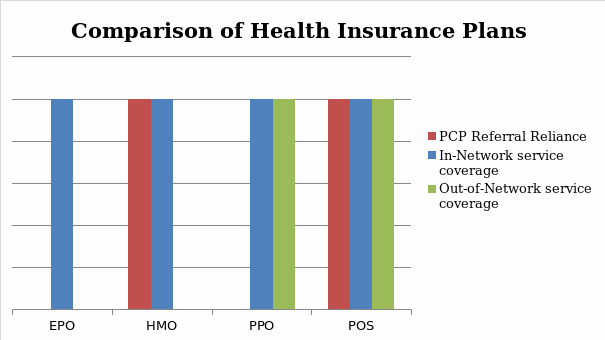
EPO is an insurance plan that covers service costs exclusively within a chosen healthcare network. That is, the majority of EPOs are willing to cover the out-of-network service cost only in emergency cases (U.S. Centers for Medicare & Medicaid Services [U.S. Centers], n.d.). Otherwise, the user will have to pay in full for the care outside the network. Some EPOs might require the users to assign themselves to a Primary Care Provider (PCP). PCPs can help manage health issues within the network; however, the users are not obliged to receive a referral before meeting another network specialist.
Health Maintenance Organization
HMOs represent a health insurance plan that allows service cost coverage with healthcare specialists and facilities bound with the HMO by a contract. Similarly to EPOs, HMOs will only cover out-of-network service costs in case of emergency. In an HMO plan, the choice of a PCP is mandatory since PCPs will be responsible for all medical care. In this context, the HMO user is not able to meet other specialists without a PCP referral.
Apart from that, HMOs might also geographically limit their services (National Library of Medicine, 2019). Nevertheless, HMOs’ in-network service costs tend to be lower compared to other plan types. Additionally, HMOs are known for their integrated approach to healthcare, which also includes prevention and healthy lifestyle promotion.
Preferred Provider Organization
As in the two previous insurance plans, PPOs ensure lower care prices within the chosen healthcare network. This time, however, the user will have to pay extra in case of out-of-network service use. On the other hand, the choice of networks available for users and the size of the networks are significantly larger (National Library of Medicine, 2019). Moreover, there is no need for the PCP choice, as PPO users are free to meet with any specialist without a referral.
Point of Service
POS insurance plans combine attributes of HMOs and PPOs, representing a hybrid managed care type. From the HMOs, POSs inherited the lower service costs within the chosen healthcare network, smaller network size, and a requirement to select a single PCP fully responsible for future care and referral management (National Library of Medicine, 2019). In the meantime, similarly to PPOs, plan users can choose either in-network or out-of-network healthcare providers. In the case of the latter choice, PPO users will have higher shares in terms of health service costs.
Conclusion
By offering different types of health insurance plans, managed care providers address the variability of needs among the population. The plans mainly differ by cost coverage share and policies toward in-network and out-of-network service use. Another difference in insurance plans lies in the plan users’ reliance on PCPs to aid, monitor, and manage their care through counseling and referrals. This way, people have freedom of choice in terms of health insurance based on their financial state, expected plan flexibility, and geographical location.
References
National Library of Medicine. (2019). Managed care. MedlinePlus. Web.
U.S. Centers for Medicare & Medicaid Services. (n.d.). How to pick a health insurance plan. Web.