Introduction
Lake Gopło, located in Kruszwica, Poland, is one of the clearest examples of such an environmental problem as water pollution with wastes and metals. Many scientists have devoted their work to studying the water quality of Lake Gopło. For example, Juśkiewicz and Gierszewski (1) point out that the lake’s water contains several heavy metals, especially Ni, Cd, Cr, and Hg. Accordingly, this concern needs a unique approach and radical solutions within the framework of several chemical sciences. To date, Gopło is one of the most polluted lakes in Poland, and its purification requires specific resolutions due to chemical reactions.
Analysis
Primarily, one should assume that the chemical reactions would provide specific solutions for neutralizing toxic metallic wastes in Lake Gopło, Poland, through a detailed analysis of pollutants and their chemical structures (see Figure 1). Understanding these aspects is essential for further interpretation of poisonous metal pollution effects on the human body, regulation of emissions, and development of pollution reduction projects and technologies.
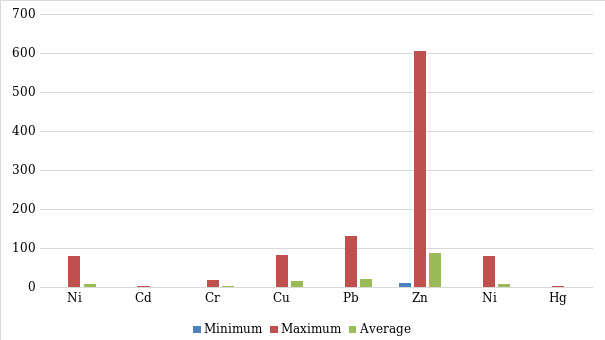
Appealing to the Geoaccumulation Index (Igeo) and Pollution Load Index (PLI), it turns out that the Gopło’s northern part has a high proportion of Ni, Cd, and Cr, the sources of which are pollutants from food industries (Juśkiewicz and Gierszewski 11).
Furthermore, these values indicate sediment contamination with Cu, Pb, Zn, Ni, and Hg (Juśkiewicz and Gierszewski 11). These metals are the most common in the environment and are highly toxic trace elements (Selvi et al. 2). However, the general condition of Gopło is good; the degree of contamination with toxic metals is insignificant in the central and southern parts of the lake. Therefore, characterizing the degree of pollution of the river and determining the presence of specific concentrations in the river’s water makes it possible to understand ways to neutralize waste and metals.
Based on the information received, corrective actions should be selected and gradually implemented in the southern part of Gopło (Tracy et al. 6). According to Tracy et al. (9), these initiatives usually include physical and chemical filtrations, classical distillation, maintaining water’s oxygen saturation, ion exchanges, removing the majority of contaminants from water, and much more. Moreover, integrated approaches like electro-kinetic (EK) processes and phytoremediation serve as an effective strategy for removing toxic heavy metals (Selvi et al. 11). Chemical reactions based on these methods will make it possible to prevent the accumulation and remove metal pollutants.
In addition, one should not neglect the preventive measures that can be applied in the southern and central parts of Gopło. These may include changes and modifications of pH caused by water contact with alkaline materials and the addition of corrosion inhibitors such as silicates, orthophosphates, and polyphosphates with appropriate dosages (Tracy et al. 9). Accordingly, these chemical reactions produce a visible result: the release of iron, soluble copper, and lead and a decrease in the tendency of toxic metals to dissolve in water. However, pollution management is best done through a structured approach (see Figure 2).

Conclusion
Summarizing the above, it is necessary to state that the pollution of Lake Gopło with heavy metals is one of the leading environmental problems in Poland. The lake contains several heavy metals, manifesting to the greatest extent in the northern part, with such dangerous elements as Ni, Cd, Cr, and Hg. However, the solution to the problem is possible due to chemical reactions in the context of preventive and corrective measures.
Works Cited
Juśkiewicz, Włodzimierz, and Piotr Gierszewski. “Toxic Metal Pollution of Aquatic Ecosystems of European Union Nature Protection Areas in a Region of Intensive Agriculture (Lake Gopło, Poland).” Aquatic Sciences, vol. 84, no. 52, 2022, pp. 1-15.
Selvi, Adikesavan, et al. “Integrated Remediation Processes Toward Heavy Metal Removal/Recovery from Various Environments-A Review.” Frontiers in Environmental Science, vol. 7, no. 66, 2019, pp. 1-15.
Tracy, J. Wren, et al. “Sources of and Solutions to Toxic Metal and Metalloid Contamination in Small Rural Drinking Water Systems: A Rapid Review.” International Journal of Environmental Research and Public Health, vol. 17, no. 19, 2020, pp. 1-18.