Introduction
A report by CNN Health, published on January 14, 2023, focused on the impact of social media on the mental health of children. Smerconish (2023) mentioned several media platforms, such as Facebook, TikTok, Twitter, and Instagram, as the leading causes of suicide and other mental health issues among school children. Social media platforms, including Facebook, YouTube, Instagram, and TikTok, have gained immense popularity in recent years.
Keles et al. (2020) explain that preadolescents, teenagers, young adults, and many middle-aged individuals are addicted to various social media platforms. Although these platforms have obvious benefits of easing communication and promoting a universal culture, they also have serious adverse effects on users. A study by Wojdan et al. (2021) reveals a concerning trend: some teenagers spend as much as 8 hours a day on these social media platforms. It is important to note that they are only left with 16 hours to attend classes, eat, and engage in other social activities. It means that most of their time is spent on these platforms.
In this study, the goal was to determine the effect of social media on emotional health as reported in CNN Health. Various studies have highlighted both the negative and positive consequences of these platforms. It has become apparent that these platforms are susceptible to misuse due to inadequate regulation. The fact that someone can remain anonymous while using these platforms makes them even more dangerous. The following was the research question that had to be addressed using data obtained from primary and secondary sources:
Is social media affecting our emotional health more than we realize? Is it benefiting us or hurting us?
The study will use the content of the message presented in CNN Health, mentioned above, to answer the question above using statistical methods, as discussed in the methodology section of this report.
Literature Review
The emergence of social media has had a profound impact on how people worldwide communicate and share information. Traditionally, different platforms had distinct functions that were not as intertwined as those of current social media platforms. Person-to-person communication can be facilitated through various means, including telephone calls, letters, emails, or texts.
Mass communication relies on mass media platforms, including newspapers, television, radio, and magazines. Allyse et al. (2018) explain that these mass media platforms were closely regulated to ensure that they remained ethical and responsible. Entertainment was available on big screens, and it was common for people to visit movie theatres.
When social media platforms like Facebook and YouTube emerged, they transformed the way people communicate. For the first time, person-to-person communication, mass communication, and entertainment were combined into a single platform (Bungin et al., 2021). People no longer have to write letters to communicate with their loved ones, as they can do so in real-time using these social media platforms.
Similarly, mass media platforms no longer control mass communication, as information can be easily shared with the masses through social media platforms. YouTube has largely replaced traditional entertainment platforms. Figure 1 below illustrates the most popular social media platforms worldwide.

Despite the clear advantages of these platforms, research has shown that they also have devastating social and health consequences. According to Keles et al. (2020), some teenagers are no longer interested in traditional social events as they become hooked on social media platforms. Outdoor games are also becoming less popular because these teens prefer spending their time using handheld devices (Dunton et al., 2020).
One of the growing concerns among medical experts is the effect of social media on the emotional health of teenagers. Cases of bullying, verbal attacks, planning of criminal activities, and suicide that are directly related to the use or misuse of these platforms have been on the rise (Bungin et al., 2021). The main problem is that most of those who are worst affected by social media do not even realize that they have a problem that needs to be addressed.
Rationale and Hypothesis
Emotional health is increasingly becoming a significant issue in mental health. A study by Faulkner and Thompson (2021) found that emotionally unstable individuals tend to underperform in their academics and their workplace. When the condition is left unchecked, an individual may suffer depression and sometimes become suicidal. It is crucial to find a way to manage the condition to prevent its devastating consequences from escalating.
Social media has been identified as a significant factor that negatively affects emotional health (Faulkner & Thompson, 2021). One can easily be exposed to hate speech, bullying, and emotional manipulation through various social media platforms. Based on the preliminary review of the literature, the researcher has developed the hypothesis stated below. Data from the primary sources will be used to test the hypothesis.
H1: Social media plays a negative role in children’s and youth’s emotional health.
Methods
In this section, the focus is on explaining the method that was used to collect and process data from primary sources. It is essential to clarify how, when, and for what purpose the data was collected. Primary data were collected to gain the views of specific individuals on the effects of social media on the emotional health of people, with a special focus on teenagers.
Data was collected by interviewing individuals who were aware of the suicide case of the 16-year-old Channing Smith from Manchester, Tennessee. Based on this case, the researcher asked participants to base their views on personal experiences related to the incident. This specific case of Smith’s suicide was chosen because of the massive publicity that it generated and how well it explained the dangers of social media platforms when they are misused.
It was also necessary to explain when and where the data was collected. The primary data were gathered from 20 local community members who were aware of the incident involving Smith or related cases, which enabled them to offer observations on the issue. It took five days to plan and conduct the interviews, as well as process the data on the issue under investigation.
As Snyder (2019) explains, researchers can opt to use either qualitative or quantitative methods to process data. In this case, the researcher opted to use quantitative/statistical methods to analyze the data from the participants in response to the message from the media mentioned in the introduction. This method was considered adequate, as it enabled the analysis of the relationship between the different variables.
The independent variable was the emotional health of the youth, while the dependent variable was the use or misuse of social media platforms. The researcher used a Microsoft Excel spreadsheet to conduct the statistical analysis of the primary data. The statistical analysis involved determining the relationship between the variables. The outcome of the statistical analysis conducted was presented in the form of charts and graphs for straightforward interpretation.
Results
The previous section explained the approach that the researcher took to collect and process primary data. In this section, the focus is on presenting findings from the analysis conducted. The secondary data has shown that there is a direct and negative impact of social media on emotional health, especially that of teenagers and young adults. It was necessary to determine if secondary data would corroborate the findings from the secondary sources.
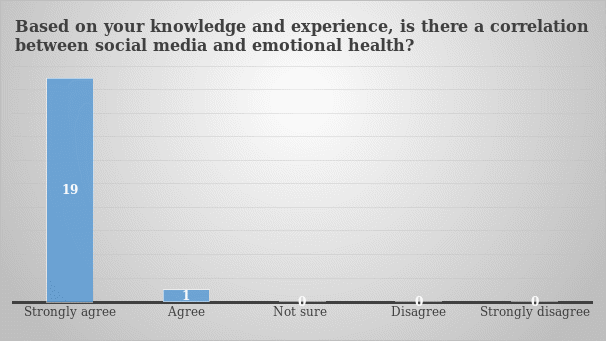
The first step was to determine if there is a relationship between social media and emotional health. The researcher directly asked the participants to state if they believed there was a correlation between the two variables. As shown in Figure 2 below, 19 participants strongly agreed with the statement that the two variables are related, while the remaining participants agreed with the statement to some extent. It means that 100% of those who were interviewed agree that there is a relationship between emotional health and social media.
H1: Social media plays a negative role in our emotional health
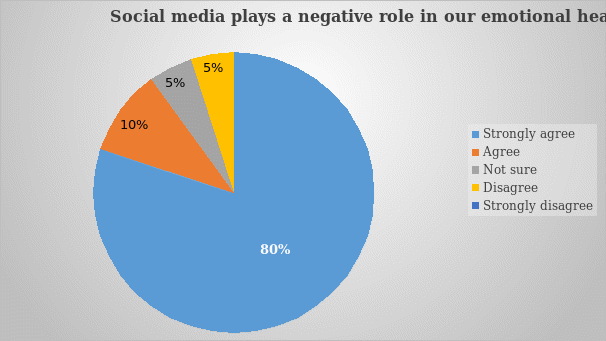
After establishing the relationship between the variables, it was necessary to test the hypothesis above. Respondents were asked to indicate whether they believe that social media plays a negative role in their emotional health. Figure 3 below shows that 80% of the participants strongly agree, while the other 10% agree. Based on the statistical strength, the hypothesis is confirmed by 90% of the participants. Only 5% held a contrary view, while another 5% were undecided. The results support the hypothesis that participants believe that social media causes mental health issues primarily because of its misuse.
Discussion
The analysis of the primary data presented in the section above confirms the findings from the secondary data. The analysis confirmed the hypothesis that was developed. It has been confirmed that social media plays a negative role in our emotional health. The findings from the analysis of primary data are significant because they reaffirm the claims made by other scholars that some social media platforms may pose a serious threat to users. Platforms such as Instagram, TikTok, and Facebook, where there is enormous pressure among users to appear perfect, pose mental health issues.
Faulkner and Thompson (2021) argue that users have a desire to be as perfect as possible. It means that those who think they are overweight or those who do not have physical attributes generally considered attractive find themselves disadvantaged. Some are often willing to go to great lengths to appear attractive. In the process, they expose themselves to serious medical dangers.
Findings made in this study show that social media can be a significant force that can lead to cases such as suicide. The suicide case of Channing Smith from Manchester is a perfect example of how dangerous social media can be to one’s emotional health. Smith was a victim of online bullying, mainly through Facebook. He reported the matter to the local authorities, but no action was taken to protect him. Finally, he decided that the only way out of the emotional pain was to take his own life (Bungin et al., 2021). This is not an isolated case, as there are numerous cases where suicides are directly linked to one’s activities on social media platforms.

The study strongly suggests that measures are needed to regulate social media platforms. The anonymity in these platforms is one of the most significant challenges because criminals and bullies know that they can use pseudonyms and attack their victims without the fear of being arrested and punished for their crimes. These social media giants need to do more to ensure that their users are protected.
Faulkner and Thompson (2021) reiterate that these social media giants are aware of the serious adverse effects their platforms have on the emotional health of users. They are aware that some of these users are deliberate in their attacks, and unless appropriate remedies are taken to deter them, they are likely to continue with their attacks. Teenagers and young adults are at the most significant risk because they are particularly susceptible to how their peers and society perceive them. As such, they deserve to be protected while using these platforms.
Conclusions
Social media plays a crucial role in promoting a world where information can flow freely and without the restrictions that traditional mass media companies often face. They have also liberalized entertainment, making it possible for the global community to understand the cultures of different people around the world. Despite the numerous benefits that these platforms offer, studies have shown that they also have a profound impact on the emotional health of their users.
Cases of suicide have been reported around the world because of cyberbullying. It has also emerged that some of the users are traumatized when they cannot achieve an image that the online community considers desirable. The study suggests that social media firms should be compelled to find lasting solutions to these challenges.
The main limitation of this study was that it did not involve a thorough review of the literature. This study is significant because it uses empirical research to establish the relationship between emotional health and the appropriate and inappropriate use of social media platforms. Further studies will be necessary to investigate how children and youths can be assisted in using social media responsibly.
References
Allyse, M., Robinson, D., Ferber, M., & Sharp, R. (2018). Direct-to-consumer testing 2.0: Emerging models of direct-to-consumer genetic testing. Mayo Clinic Proceedings, 93(1), 113-120. Web.
Bungin, B., Wono, H., & Shwari, J. (2021). Communication media technology and social harmony construction in the era of society 5.0: A critical view. International Journal of Computer and Information System, 2(4), 125-130. Web.
Dunton, G., Do, B., & Wang, S. (2020). Early effects of the COVID-19 pandemic on physical activity and sedentary behavior in children living in the US. BMC Public Health, 20(1), 1-13. Web.
Faulkner, A., & Thompson, R. (2021). Uncovering the emotional labor of involvement and co-production in mental health research. Disability & Society, 4(1), 67-78. Web.
Keles, B., McCrae, N., & Grealish, A. (2020). A systematic review: the influence of social media on depression, anxiety and psychological distress in adolescents. International Journal of Adolescence and Youth, 25(1), 79-93. Web.
McCormick, K. (2022). The 6 biggest, worst, most popular social media platforms (+how to wield their power). World Stream. Web.
Smerconish, M. (2023). Social media impact on kids’ mental health decline. CNN Health. Web.
Snyder, H. (2019). Literature review as a research methodology: An overview and guidelines. Journal of Business Research, 104(1), 333-339. Web.
Willingham, J. (2019). The family of a teen who died by suicide after being outed by cyber bullies is demanding justice. CNN. Web.
Wojdan, W., Wdowiak, K., Witas, A., Drogoń, J., & Brakowiecki, W. (2021). The impact of social media on the lifestyle of young people. Polish Journal of Public Health, 130(1), 8-13. Web.