Introduction
Operational amplifiers are key components in analog electronics and are widely used in signal processing, amplification, filtering, and mathematical operations. The functionalities are made possible by the unique features exhibited by the different types of amplifiers. This laboratory report investigates the key features of three op-amps: inverting, non-inverting, and voltage follower amplifiers. The primary objective of the experiment is to prove that the amplification in a voltage follower is one, while the inverting amplifier amplifies the input and changes its polarity.
Theory
Analog electronic circuit design depends on three key configurations to function effectively. The first configuration is the voltage following the circuit where the expected gain is unity. On the other hand, a non-inverting amplifier circuit will be desirable when the user wants to increase the signal while maintaining the polarity (Rashtian, 2022). Lastly, an inverting amplifier will be desirable when the user intends to amplify the signal and then change its polarity.
Pre Lab
The pre-lab questions are essential because they help the learner understand the concepts and familiarize themselves with the theoretical background of the experiment. In this experiment, the pre-lab exercise was to derive expressions for the closed-loop gain for both inverting and non-inverting amplifiers. Figure 1 shows the derivation of the expression for an inverting amplifier, while Figure 2 represents the derivation for a non-inverting amplifier.


Experiment Set Up and Procedure
Procedure 1: Voltage Follower
The 741 amplifier was connected, as shown in Figure 3 below, with an oscilloscope and a DC voltage source. The DC voltage was set to 12V, and the oscilloscope monitored and recorded the output. Further, the voltage was adjusted to +1V, +2V, and +3V, and all were recorded. A sinusoidal input was applied as the measurements were taken. The relationship between the input and output was measured and then adjusted to an amplitude of 2V and 3V, respectively, and the output was recorded.

Procedure 2: Non-inverting amplifier
The 741 op-amp was connected, as shown in Figure 4 below. The input was set to 12V, and two resistors, 8.2k Ω and 150 Ω, respectively. The input was set to +500mV and +750mV, and the output was recorded. A sinusoidal input was applied at ±25mV, -20dB, and 1 kHz input, and the output was also recorded. The amplitude was further adjusted to ±750mV, and the output was recorded.

Procedure 3: Inverting Amplifier
The experiment was set up as shown in Figure 5 below. The 741 op-amps were connected to the set input of 500mV and 750mV, and the oscilloscope recorded the output. A sinusoidal input of 500mV and 50Hz was then applied. The process was repeated after changing the third resistor from 470Ω to 1.5kΩ.

Results
Table 1: Results for Experiment 1
Table 2: Results for Experiment 2
Table 3: Results for Experiment 3
Data Analysis and Discussion
The three experiments tested three different configurations, which could be determined by calculating the gain. The equation below shows that the amplification factor is given as the output divided by the input. Table 1 shows the values for the voltage follower, and the following gain is obtained from the recorded values.



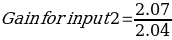

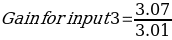



Table 2 shows the gain for a non-inverting amplifier in which the voltage is multiplied by an amplification factor. Table 3 gives data for the inverting amplifier and shows that the gain has a different polarity. The different features of the op amps show their different uses.




Conclusion
The overall aim of the lab was met because all the features of the three operational amplifiers were determined mathematically. The voltage follower was found to have a unit gain, and the input signal was not amplified. Further, the non-inverting had a similar polarity to the input but was multiplied by a factor. The inverter amplified the signal but reversed its polarity, making each suitable for its desired work.
Reference
Rashtian, M. (2022). High-Gain and High-Slew-Rate Two-Stage Class A–AB Op-Amp. Iranian Journal of Science and Technology, Transactions of Electrical Engineering, 46(1), 235-243. Web.