Introduction
The conceptual core of geometrical optics is based on the rectilinear propagation of light in a homogeneous medium as long as the light beam does not collide with an obstacle. When a collision occurs, the trajectory of the beam changes; that is, the beam is said to be deflected, with the angle of incidence always equal to the angle of reflection, according to the laws of optics (Bennett, 2022).
Notably, in geometric optics, the wave properties of light are ignored. Still, the direction of a beam or beam of rays depends on the angle of incidence and the nature of the materials (media) in which light propagates. In the present laboratory work, variously shaped reflecting surfaces are used to test the reflection properties of a beam of light at different angles and to empirically determine the refractive index of the medium in which the ray energy propagates.
Data
Appendix A shows different configurations of the laser light beam propagation using differently shaped mirrors.
Procedure
The experiment consisted of several successive parts, each using differential settings. First, a laser beam was incident on a flat mirror, and several incidence angles were used to estimate beam reflection angles. Second, a concave mirror was used on which three laser beams were incident, and the focal distance was calculated for their configuration.
In the third and fourth experiments, rectangular and triangular prisms were used, respectively: in each case, the beam was directed according to the methodical instructions, and the refractive index was calculated for the rectangular prism. A biconvex lens was used in the fifth experiment, for which the focal length was also determined. The focal lengths were determined for the biconvex and plano-convex lenses in the sixth and seventh experiments. All data were plotted in Appendix A’s Laser Optical Disc diagram.
Results
Calculations
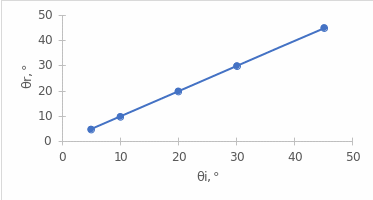
For the first part of the experiment, the incidence angles were always equal to the reflection angles for each incoming beam configuration, confirming the law of refraction of geometric optics. In the second part, at the intersection of the incident and reflected rays, the focal distance was defined as 1.5 cm. For the third experiment, the angle of incidence of the first ray was 45°, and the angle of reflection was 30°. Considering that the light initially propagated in the air (n = 1) and as shown in Equation [1], the refractive index of the rectangular-prismatic lens was 1.41.
In the fourth experiment, each ray incident on the triangular-prismatic lens was refracted inside the lens at different angles but returned to its original state on exit, as shown in Appendix A. The focal distance was defined as 9.5 cm in the fifth and sixth experiments. In the last experiment with the double-curved lens, the focal distance was determined at the intersection of the rays at 4 cm.

Data Analysis
- The accuracy of distance and angle measurements is based on instrumental uncertainties and errors.
- The relationship between the angle of incidence and the angle of reflection is linearly ascending, as shown in Figure 1.
- As shown in Appendix A, both focal lengths are 1.5 cm each, but this is not surprising since the lens is symmetrical.
- The refractive index was determined to be 1.41, which is higher than the refractive index of air. The accuracy of the results is determined by the accuracy of the measured angles and measurement errors, as well as the assumption that the index of refraction of air is equal to one.
- The focal lengths of the curved mirrors were identical, for the plano-convex lens were 6 and 9.5 cm, respectively, for the biconvex 6.5 and 9.5 cm, and for the biconvex 4 cm each. The difference between the focal distances is determined by the asymmetrical shape of the lens through which the paraxial and marginal rays pass.
- In the case of the plano-convex lens, the light propagated non-detectably from left to right and from right to left. The reason for this is the different shapes of the lens: flat on one side and convex on the other.
Conclusion
In this laboratory work, the laws of light propagation according to geometric optics were verified. Several different shapes of lenses and reflective surfaces were used for laser beams to study their reflection behavior, calculate lens focal lengths, and determine the material’s refractive index. The laboratory work can be considered a success because the results were obtained, and the objectives were met.
Reference
Bennett, C. A. (2022). Principles of physical optics. John Wiley & Sons.
Appendix A


