Abstract
This research paper measures the relationship between sleep duration, self-satisfaction, and work productivity. For this purpose, 73 respondents measured the hours they slept during the week and rated themselves on a hundred-point scale of self-satisfaction and occupational productivity. The data were subjected to regression analysis, which revealed that longer sleep was positively associated with self-satisfaction and work satisfaction, and negatively correlated with the number of workdays missed and mistakes made.
Introduction
The duration and quality of sleep are essential aspects of an individual’s daily life, influencing the accuracy of the body’s metabolic processes and psychological well-being. Sleep is often insufficient in a rapidly developing world, especially in urban environments. People often experience a frequent lack of sleep and insomnia, which can result in irritability, increased stress, and communication difficulties (Šmotek et al., 2020).
This creates contradictory conclusions, as city life for most people is associated with work, and the lack of sleep caused by an accelerated life rhythm can negatively affect the quality of such work. This research project is based on the hypothesis that a significant relationship exists between sleep duration and an employee’s work performance, with an increase in one variable expected to lead to an increase in the other.
In other words, the less sleep an individual gets, the worse their work performance is, and vice versa. In addition, it was interesting to discover how sleep duration affects employee self-satisfaction: Can it be said that there is a positive correlation between the two? The present work is based on regression analysis of data collected from 73 adult respondents with full-time jobs and living in the city.
Methods
The methodological basis for this study was to conduct a statistical analysis to determine relationships among quantitative variables. A systematic probability sampling mechanism was employed to generate the sample, where all potential participants meeting the inclusion criteria were entered into a common list in an Excel spreadsheet. Each was assigned a random number, and only 90 were selected after the numbers were sorted. Each participant was sent an invitation to participate in the research project, along with instructions on how to collect and report the data.
The collected data were recorded in SPSS, where statistical analysis was performed. Data processing included linear regression analysis to determine the nature of the relationships between the variables. The data included measures of demographics to determine the mean respondent portrait, sleep duration as the independent variable, and self-satisfaction and work performance as dependent variables.
Sleep duration was assessed over a week: respondents recorded the hours they slept each day for seven days, after which these data were averaged. Self-satisfaction was assessed on a hundred-point scale at the end of the week: participants were asked to rate their life satisfaction. Finally, the Barnes & Watson (2019) multicomponent system was chosen to measure work performance. The number of mistakes made, the number of days missed per week, and job satisfaction were assessed as aspects of work performance.
Results
Seventy-three individuals (81.1%) responded to the invitation to participate, which formed the basis of the sample used in this study. The sample consisted of females (63.0%, n = 46), with a mean age of approximately 32 years (SD = 7.0). Thus, data were collected predominantly from adults with stable jobs. Regression analysis examined the relationship between mean sleep duration and individuals’ self-satisfaction. It was found that the linear model was significant, F(72) = 79.149, p <.001. The regression equation determined that when sleep duration increased by one hour, self-satisfaction increased by 9.7 points (Figure 1).
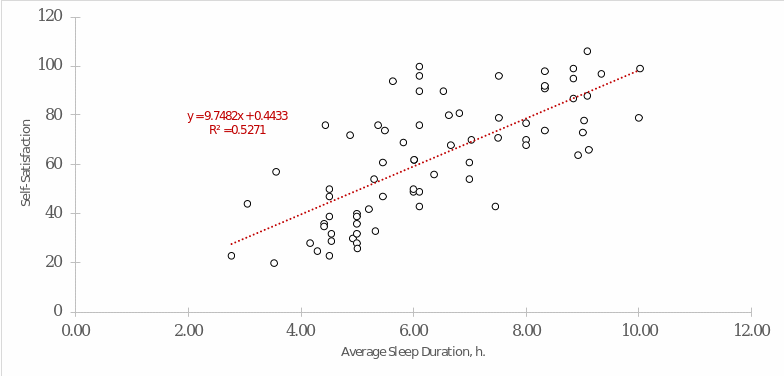
To measure the relationship between sleep duration and work performance, three regression analyses were run for each of the performance aspects. For work satisfaction, the model was significant, F(72) = 67.555, p <.001, and the slope of the regression function was 10.1 (Figure 2a). For the number of errors committed, the regression was also significant, F(72) = 45.715, p <.001, and the relationship between the variables was the opposite: the slope was -0.853 (Figure 2b).

A similar situation was observed for the relationship with some days missed: F(72) = 23.529, p <.001, the slope is -0.460 (Figure 2c). These results show that sleep duration was positively correlated with work satisfaction and was negatively related to the number of errors made and days missed.
Discussion
Findings
This research paper aimed to investigate the relationship between sleep duration, self-satisfaction, and employee work performance. The average age of the respondents in the sample allows us to judge the participants as sufficiently adult, independent, and capable, and thus experienced in working and living in an urban environment, which, among other things, was the inclusion criterion for the sample.
The results of this analysis correspond well with the initially stated hypotheses. Indeed, it was found that increasing sleep duration positively affected self-satisfaction: longer duration increased this psychosocial aspect. At the same time, the expected relationships between sleep duration and work performance were found. Employees who slept less were more likely to make mistakes and miss workdays, showing lower productivity. At the same time, respondents who averaged more hours of sleep were more satisfied with their work.
Comparison to Other Studies
While the results are expected, placing them in academic discourse to assess consistency is interesting. Barnes and Watson (2019) examined the relationship between sleep duration and work performance through a systematic review. The researchers’ unequivocal conclusion is that healthy sleep is good for business, which is also supported by the regression analysis results. The authors discuss the implications when they say that business leaders need to consider whether their employees are getting enough sleep or have to contend with sleep deprivation and insomnia due to occupational stress and burnout.
Parametric statistical analysis was used in the work of Šmotek et al. (2020), who investigated the effect of phone use before bedtime on respondents’ psychosocial metrics. They found that using devices immediately before falling asleep was associated with sleep latency, communication inertia, and work dysfunction. This study supports the findings as it also shows that reduced sleep duration caused by phone use before falling asleep can impair personal and professional development. A real-world experiment examining the effects of daylight on sleep duration and the resulting work performance of respondents was conducted by Boubekri et al. (2020).
The authors’ findings showed that using special glass as a daylight filter in offices increases sleep duration, which in turn proves to be more beneficial for work performance. In other words, the scientists showed that longer sleep was positively correlated with workers’ cognitive performance, which also supports the findings of the current project. Thus, the regression analysis results fit perfectly within the findings of the academic discourse and show no contradictions.
Limitations
The study has some limitations that could affect the validity of the results. In particular, the collection of sleep duration data was not controlled in any way, so one would expect that participants encountered Hawthorne effects. In addition, the findings were only valid for urban dwellers and can hardly be extrapolated to workers in rural areas. Work on these limitations is part of future research. Including in the future, it will be interesting to see how sleep time for full-time day workers is related to the variables investigated.
References
Barnes, C. M., & Watson, N. F. (2019). Why healthy sleep is good for business. Sleep Medicine Reviews, 47, 112-118. Web.
Boubekri, M., Lee, J., MacNaughton, P., Woo, M., Schuyler, L., Tinianov, B., & Satish, U. (2020). The impact of optimized daylight and views on the sleep duration and cognitive performance of office workers. International Journal of Environmental Research and Public Health, 17(9), 1-16. Web.
Šmotek, M., Fárková, E., Manková, D., & Kopřivová, J. (2020). Evening and night exposure to screens of media devices and its association with subjectively perceived sleep: should “light hygiene” be given more attention? Sleep Health, 6(4), 498-505. Web.