Introduction: Purpose
- Rapidly evolving business environment
- Staffing changes
- Assessment of market trends and internal needs for new strategies aligned with goals
- Necessity of collaboration, correct job descriptions, fair compensation, and effective performance appraisal
- Goals: understanding of initiatives and priorities for staffing decision-making
- Communication and strategic planning for a smooth transition
A rapidly evolving business environment is characterized by inevitable staffing changes that should be considered for the company’s stability and further development. In particular, an ability to assess and interpret market trends in human resources, along with internal conditions and needs, helps correct organizational processes and the HR department’s approaches, aligning them with strategic goals.
Therefore, this presentation describes perspectives that managers and HR should consider to help the company adapt to changes and minimize the negative consequences of their ignorance. In particular, it highlights the necessity of collaboration, correct job descriptions, fair compensation, and effective performance appraisal. The primary purpose of these educational materials is to ensure department managers’ understanding of organizational priorities for thoughtfulness in staffing decisions. Transparent communication and strategic planning are key components of a smooth transition.
Areas of Critical Importance for Collaboration Between HR and Managers
Talent acquisition
- HR – development of recruitment strategies and applicant screening
- Managers – evaluation of candidates’ skills and potential
- Objectivity of hiring processes
- Attraction of qualified employees
- Further professional development
As the workforce is currently regarded as a company’s most valuable resource, the HR department and managers should cooperate for talent acquisition to attract and select the most outstanding and qualified specialists who will fit not only for their roles but for organizational culture as well (Pandey & Sarangi, 2023). In the recruitment process, HR should be responsible for developing efficient sourcing and applicant screening strategies, including attractive job postings and interview guides. At the same time, managers will evaluate candidates’ technical and soft skills, creativity, and team compatibility based on previously elaborated criteria. This collaboration guarantees the objectivity of hiring processes and the attraction of qualified employees and contributes to their further professional development.
Planning and Forecasting
- HR – assessment of market trends and tendencies in talent acquisition, workload, turnover, and retirement
- Managers – evaluation of departmental needs and skill gaps, the development of succession plans, and operational goals
- Collaboration for the prevention of workforce challenges and the alignment of changes and objectives
As planning and flexibility are modern necessities for a company’s growth and development, HR and managers should cooperate to assess departmental needs and future market trends to forecast changes and prepare for them. In particular, managers evaluate current staffing needs and operational demands, develop succession plans, analyze existing skill gaps, and specify operational goals. HR observes labor laws and tendencies in talent acquisition and applies data analytics to forecast workload, retirement, and turnover rates. Their collaboration prevents potential workforce challenges and aligns strategic objectives, market changes, and workforce goals.
Effective Job Descriptions
Process: Job analysis – Description of key duties, qualifications, and work conditions – Review of accuracy, clarity, and compliance with legal standards and non-discriminatory practices– Validation – Availability
Elements:
- Job title
- Duties
- Requirements (education, skills, experience)
- Working conditions
To create an efficient job description, data related to required skills and primary responsibilities, the company’s resources, and competitors’ offers should be collected to describe an employee’s key duties, qualifications, and work conditions. Subsequently, HR and managers should ensure a description’s clarity, accuracy, and compliance with legal standards and non-discriminatory practices before making it available to applicants. Therefore, a job title, the description of duties, requirements, and working conditions are the key elements of a description.
Considerations for Compensation and Benefit Plan Development
Internal Fairness and Equity
- analysis of competitive salaries
- Pay equity analyses for the creation of a compensation framework
- alignment with positions, efforts, and achievements (Rasheed et al., 2020)
- prevention of employees’ dissatisfaction, low job commitment, and turnover
Compensation and benefit plans should be based on position, contribution, and achievement fairness (Rasheed et al., 2020). For its improvement, pay equity analyses should be performed to address disparities and create a comprehensive compensation framework that clearly defines levels, grades, and additional criteria for payment. The ignorance of equity leads to pay disparities that negatively impact employees’ job satisfaction, morale, commitment, and retention. Preventing these negative consequences and an additional financial burden requires transparent communication between managers regarding pay decisions, managing expenditures, and compensation advancements.
Market Competitiveness
- analysis of competitive salaries (Kang & Lee, 2021)
- regular monitoring (surveys and benchmarking)
- salary surveys
- Assessment of emerging benefit trends and regional living costs
- Adjustment of pay ranges and benefit plans
In turn, fairness in compensation and benefits, along with the company’s goal to attract talented, qualified, and experienced specialists, derives from the analysis of salaries within the company’s industry and by regional norms. The absence of regular monitoring affects the company’s competitiveness and ability to attract competent workers (Kang & Lee, 2021). As a result, in collaboration with managers, the HR department should conduct salary surveys regularly and assess emerging benefit trends and regional living costs to adjust the company’s pay ranges and compensation plans, aligning them with commonly accepted standards and changing market dynamics.
Recommendation for an Appraisal Methodology
Behaviorally Anchored Rating Scales (BARS):
- Clarity in evaluation criteria
- Objectivity (Hadi et al., 2022)
- Definition of employees’ strengths and weaknesses for improvement
- Promotion of accountability and motivation
- Delivery of feedback
- Customization
Behaviorally Anchored Rating Scales (BARS) is a highly recommended appraisal methodology for assessing employee performance due to its clarity and objectivity based on distinct criteria for level eligibility (Hadi et al., 2022). In particular, it minimizes biases associated with an unclear formulation of criteria for performance evaluation, defines every person’s strengths and weaknesses, and promotes employees’ accountability for productivity and motivation. Moreover, this tool allows managers to provide constructive feedback for improvement. BARS may also be customized to the company’s strategic goals and objectives.
Conclusion
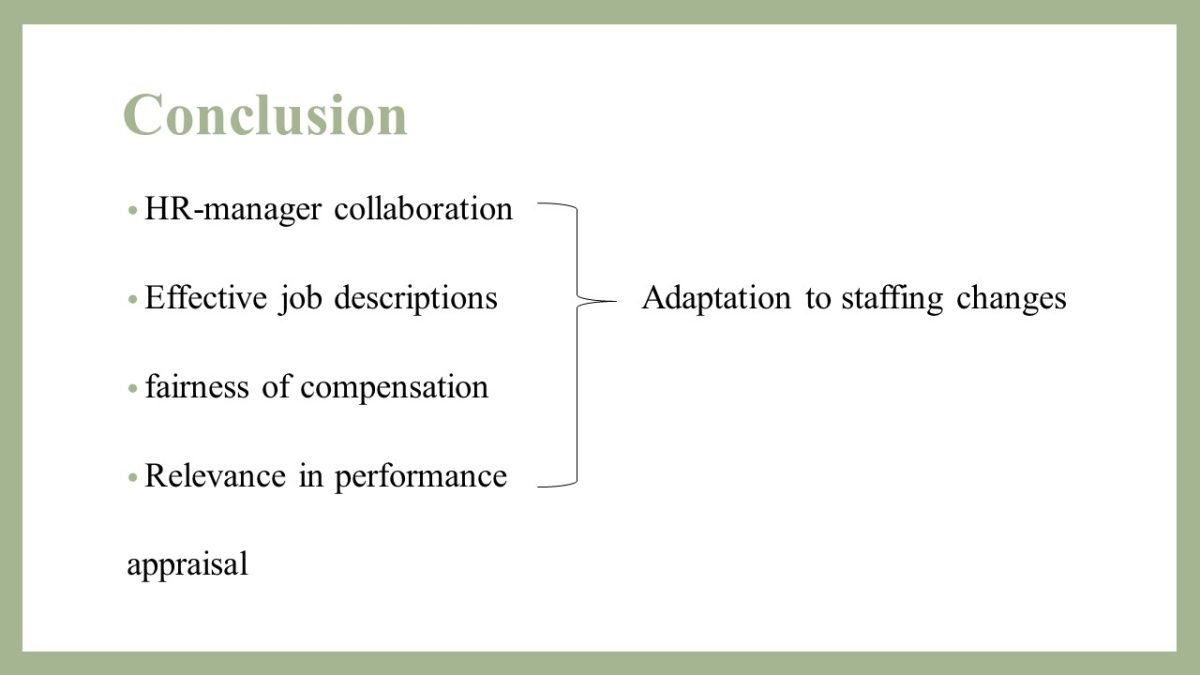
- HR-manager collaboration
- Effective job descriptions
- Fairness of compensation
- Relevance in performance appraisal
- Adaptation to staffing changes
To conclude, this presentation demonstrates that HR-manager collaboration, creating compelling job descriptions, paying particular attention to the fairness of compensation, and applying a relevant performance appraisal method ensure a smooth adaptation to staffing changes. These strategies allow for recruiting and retaining qualified and experienced specialists, assessing their suitability and commitment to their roles.
References
Hadi, K., Iskandar, I., Fitriadi, F., & Ariqah, M. (2022). Employee performance assessment with Behaviorally Anchor Rating Scale (BARS) approach: A case study. International Journal of Innovative Science and Research Technology, 7(7), 1352-1357.
Kang, E., & Lee, H. (2021). Employee compensation strategy as sustainable competitive advantage for HR education practitioners. Sustainability, 13(1049), 1-23.
Pandey, R. K., & Sarangi, S. (2023). A case study on talent acquisition at Organisations. International Journal of Engineering and Management Research, 13(1), 6-11.
Rasheed, M. I., Jamad, W. N., Pitafi, A. H., & Iqbal, S. M. J. (2020). Perceived compensation fairness, job design, and employee motivation: The mediating role of working environment. South Asian Journal of Management, 14(2), 229-246.