Introduction
In the ever-changing education environment, it is difficult to exaggerate the role of data in shaping educational practices. In this reflection piece, the author dissects how teaching methods are data-driven, with a particular emphasis on identifying students, selecting learning objectives, and developing targeted learning activities. The goal, therefore, is to demonstrate that, when coupled with wisdom learned over time, data becomes a catalyst for effective instructional design.
Identification of Student
The selected student was identified through a pervasive process that relied on multiple sources of information. Initial assessments, such as Istation reading, provided helpful details about each student’s reading ability. Emma was chosen after evaluating her performance across different aspects, with each considered holistically. Furthermore, personal behavior data trackers and teacher observations augmented it with patterns indicating issues in Emma’s decoding, language comprehension, and reading comprehension.
Choosing the Guided Objective
The determination of instructional goals for Emma aligned with the data analysis process. Assessment of Independent Reading Levels identified weaknesses in decoding, language comprehension, and reading comprehension, specifically for Emma. These weaknesses informed the learning objectives (Melnyk et al., 2021). It was not enough to tackle Emma’s challenges; it was also necessary to ensure that the corresponding learning objectives addressed her needs appropriately and aligned with broader educational targets.
Creation of a Learning Activity
Creating targeted learning activities required a deeper understanding of Emma’s strengths and weaknesses. To improve decoding, there will be targeted exercises on specific words such as “choose,” “are,” and “see.” In addition, while studying language, elements have been explicitly included in comprehension activities using other sentences or phrases until students’ proficiency improves significantly, without leaving any ambiguities for students to interpret correctly (Melnyk et al., 2021). To improve reading comprehension skills, one main activity involved silent reading and then retelling stories using transition words such as “First,” “Then”, and last.”
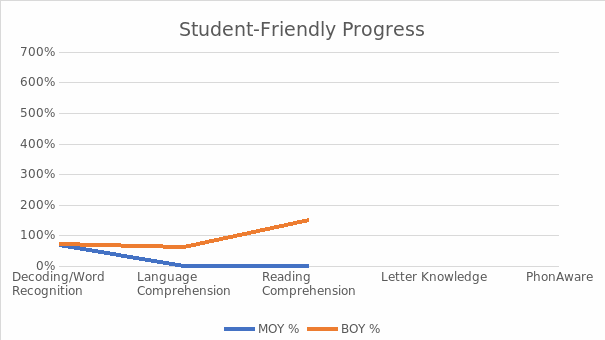
Targeted Plan explanation for colleagues:
- Decoding/Word Recognition: Emma has shown a decrease in Decoding/Word Recognition and Language Comprehension.
- Language Comprehension: Reading Comprehension score has dropped significantly; additional support is needed.
- Reading Comprehension: PhonAware skills are strong, but attention to specific areas may enhance them.
- Letter Knowledge: Suggest collaborative efforts to address Emma’s individual needs.
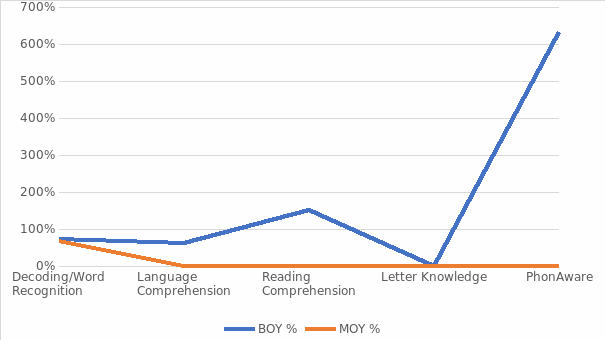
Collection, Arrangement, and Interpretation of Data
Multiple assessment tools were employed, including Istation reading scores, individual behavior data trackers, and teacher observations, which together made up an all-inclusive dataset. These records were well-organized, with a focus on specific skills, in particular decoding, language comprehension, and reading comprehension. The Beginning-of-Year (BOY) and Middle-of-Year (MOY) percentages are compared to identify growth or stagnation (Kortecamp & Peters, 2023; see Figures 1 and 2). It is this systematic approach that enabled a deeper understanding of the student’s strengths and areas for improvement.
Data as a Primary Resource
Data is a fundamental pillar of instructional decision-making; it serves as a compass, guiding educators toward more accurate, precise, and relevant lessons. For effective teaching, it is necessary to know each student’s needs to develop instructional plans that target them precisely, right? It lets tutors set precise performance goals and exercises, so that not all teaching is universal; rather, personalized learning experiences occur. In summary, it shifts education from a general practice to a practice tailored to individuals’ needs.
Ethical and Professional Responsibilities
The assessment practices adhered to comply with ethical and professional responsibilities. The key focus is not on using data punitively but on using it to guide what should be done differently next time. Maintaining privacy and confidentiality ensures the careful handling of the student’s information (Konovalenko et al., 2021). Being ethically responsible also means transparently communicating with peers so they understand why we analyze data and the steps we take to support positive outcomes for the learner involved.
Sharing the Plan with Families and Stakeholders
In any targeted teaching plan, cooperation between families and stakeholders is essential. The strategy can be shared through clear, open lines of communication, such as parent-teacher meetings, printed reports, or digital platforms. It should include a summary of Emma’s progress, learning objectives established, and activities to be undertaken for effective learning. This helps create a sense of shared responsibility by involving parents in the educational process (Konovalenko et al., 2021). Encourage questions when getting feedback from them, which helps ensure this partnership is indeed joint.
Conclusion
Data serves as a compass, guiding a learner in an educational system marked by diversity. In this reflective exploration, we can see that leveraging data involves knowing what individual students need so that their problems can be addressed. It has been about being exact at every step since then – from collecting diverse resources to analyzing them, to creating appropriate learning activities. Educators have thus used data as a significant resource to mold instruction beyond generic prescriptions towards each learner’s particular needs.
References
Konovalenko, T. V., Yivzhenko, Y. V., Demianenko, N. B., Romanyshyn, I. M., & Yemelyanova, Y. S. (2021). The possibilities of using distance learning in the professional training of a future foreign language teacher. Linguistics and Culture Review, 5(S2), 817-830.
Kortecamp, K., & Peters, M. L. (2023). The Impact of a High-Dosage Tutoring Program on Reading Achievement of Beginning Readers: A Multi-Level Analysis. Journal of Education for Students Placed at Risk (JESPAR), 1-19.
Melnyk, N., Maksymchuk, B., Gurevych, R., Kalenskyi, A., Dovbnya, S., Groshovenko, O., & Filonenko, L. (2021). The establishment and development of professional training for preschool teachers in western European countries. Revista Romaneasca Pentru Educatie Multidimensionala, 13(1), 208-233.