Introduction
Using statistics to study a community’s demographic characteristics has significant practical value for both societal and academic purposes. Equation fitting based on retrospective data establishes a connection between theoretical concepts regarding how a parameter changes over time and a set of accurate data. It can thus be used to estimate an equation that describes a demographic parameter.
This paper uses the population of Mumbai, India, as the parameter of interest. The retrospective population data was collected online, including values from 1950 to 2023. The report enables data fitting and ultimately constructs a model of the dependence of population size on time as employment prospects evolve.
Data Collection
For this paper, two sources of data were utilized: an online platform containing Mumbai population records and a previous phase of the overall project, specifically Act A. Firstly, the population data for the Indian city was exported from Macrotrends and included both the year of observation and the recorded population (Mumbai, India Metro Area Population 1950-2023). Second, Act A constructed an exponential model of the relationship between population size and employment projections, shown below:

In this model, P(t) represents the specific value of the population at a given point in time, e is an exponential constant approximately equal to 2.718, r is a measure of annual population change, and t is a factor of time or employment prospects. These indicators are unknown at this point and become definite only after fitting, as all the data have been collected, making it acceptable to analyze them.
Data Analysis
According to the assignment, not all population data were to be used, but only a sample of it. For this purpose, a randomization strategy was employed: a random value was assigned to each data point in Excel using the =RAND() function. After sorting, the first 15 values were selected and plotted on a scatter plot, as shown in Figure 1 (Puneet). An exponential approximation was constructed for this model, indicating both the coefficient of determination and the equation describing the relationship between the variables, as shown in Figure 2.


From this step, the characteristics of the model constructed earlier are clear:

Specifically, the initial population size (in year zero) is equivalent to, and the rate of population change is 0.0281. In other words,

As can be seen, the coefficient of determination for the sample data is 0.9469, indicating that the model explains 94.69% of the variance in the population statistic (Turney). The model can be tested for accuracy using population data. This is done by using Excel to find the predictive values of the population according to the model constructed above (Bliss et al. 26). The percentage error was found using the formula shown below:
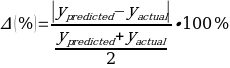
After averaging the percentage error for each data point, it was found that the average model error was 10.6%. In other words, overall, the exponential model was quite accurate, with a numerical determination of 89.4%.
Predictions
Building an exponential model is of practical value in that it provides opportunities for predicting the value of the target variable (Bliss et al. 18). Specifically, for the year 2025, the projected population is defined by the equation:

For 2030:

For 2050:

For 2100:

The projection shows that over the next few decades, the population is expected to increase by 170.2% by 2100, or nearly twelve times the current population of Mumbai.
Interpretation
Predictive models can help understand population dynamics, but it is essential to remember that there are limitations and external factors that can disrupt predictive planning. Such factors should include political influences related to the potential for birth control, epidemiological factors, and tourism and occupational characteristics that affect the outflow or inflow of labor to Mumbai. The accuracy of the sample-based model fitted to the data was relatively high, with a numerical value of 89.4% and a coefficient of determination of 94.69%. The model shows exponential population growth in the Indian city of Mumbai, including a dramatic increase in population by 2100.
Conclusion
The objective of this paper was to construct a predictive exponential model to investigate and predict the population of Mumbai. The analysis was based on random sample data, and it was demonstrated that, in correlation with population statistics for 1950-2023, the average error of the model was only 10.6%, which is a reasonably low result. The model can be used satisfactorily to predict the population of Mumbai, including employment prospects, over time. The predictive values have been calculated, and all the results have been obtained. In summary, the main conclusion is to create a highly effective model for describing the population dynamics of the Indian city of Mumbai over time.
Works Cited
“Mumbai, India Metro Area Population 1950-2023.” Macrotrends.
Bliss, Karen M., Kathleen R. Kavanagh, and Benjamin J. Galluzzo. Math Modeling: Getting Started and Getting Solutions. Society for Industrial and Applied Mathematics, 2014.
Puneet. “Randomize a List (Shuffle Data using Random Sort).” Excel Champs.
Turney, Shaun. “Coefficient of Determination (R²) | Calculation & Interpretation.” Scribbr.