Evaluation of the Existing Business Process
This essay aims to explore the responsibilities of AEON’s marketing management through a critical analysis of the challenges faced by marketers in the digital age and the changes that occur in marketing practices and thinking as a result of changes in the social and innovative environment. AEON operates nearly 4,000 locations worldwide through ownership, joint ventures, and investments. Over the years of its operations, AEON (Hong Kong) has focused on customer satisfaction by delivering its requirements and offering value to the clients (Hiroaki, 2021).
The company owns a 100% stake in Laura Ashley clothing and a 60% stake in The Talbot Women’s Wear in the United Kingdom. It operates all its stores in Japan and is the largest retailer in the country. The AEON has more than 300 consolidated subsidiaries and 25 stock model companies (Wang & Ghauri, 2020). Partners include specialist stores, shopping malls, supermarkets, and convenience stores.
Essential Components for Effective Business Operations Management
AEON (Hong Kong) creates value for its customers by embracing technical and practical digital transformation. Technology has a significant impact on the way customers and businesses interact. The operation prompted AEON’s management to focus on digital marketing. Regardless of its achievements, a company like AEON must be prepared to face the new challenges posed by technological advances. Marketers recognize the benefits of a digital approach to generating leads and enhancing customer engagement.
They also consider that there will always be obstacles, even if updated digital marketing strategies offer better solutions to the existing challenges. This is particularly relevant when applying Maslow’s hierarchy of needs theory to satisfy everyone’s goals and needs (Ryan et al., 2020). The unpredictable online behavior of customers also poses difficulties for AEON’s marketing efforts.
Marketers must always be alert to changes as needs change more rapidly due to technological improvements. As a result, AEON tools should enable alternative behaviors when creating digital marketing models (Srinivasan & Eden, 2021). Digital retailers must respond quickly to customer demands to keep AEON relevant in retail.
Application of Soft Systems Methodology (SSM)
The company’s soft systems include using artificial intelligence algorithms to promote its wares to target markets. Artificial intelligence has long been used primarily in computers. Since most marketing countries have adopted automation for time-sensitive tasks, AI is the most preferred approach in the marketing sector, especially for retail (Scott et al., 2017). Self-renewing frames are at the heart of AEON’s research and development efforts.
For example, a company optimizes its search engine using different algorithms based on its network experience. Technology can quickly adapt to online shopping techniques due to self-updating frameworks. Unfortunately, AEON’s marketers could improve their ability to forecast and anticipate consumer demand, suggesting that marketing efforts may need to be updated. Enterprise digital marketers are under constant pressure to meet new challenges and keep pace with the rapid advancements of AI robots.
AEON dealers recognize that customers are crucial to their daily operations. Digital marketing initially became highly segmented, resulting in consumers receiving limited offers (Scott et al., 2017). Users rarely see social media advertisements for services or goods they do not want to purchase. Customers are outraged by the technology, but retailers reap fewer benefits from it.
Thanks to the increased ability of AEON digital marketers to create more focused and timely marketing messages, their creativity has increased (Moore, 2019). This modification is necessary due to the large number of data trails left by customers’ online activities. Due to the increasing diversity of data and interactive experiences, as well as the digital world’s ability to provide more detailed information about the types of services required, customer expectations are becoming more sophisticated. The consumer goods sector evolves to meet the needs of individual customers.
AEON serves a large number of customers in the Asia-Pacific region, making it challenging for retailers to understand each customer’s unique preferences and interests. Digital marketers must deal with demanding customers who expect highly personalized service (Scott et al., 2017). This is true even if people’s preferences change over the course of their lives.
Digital marketers at AEON also need help maintaining a complete picture of their customers. Marketers can use the inbound method to monitor, control, and improve customer interactions (Jamshidi & Robusta, 2021). According to Digital Marketers, all digital platforms must offer the same experience. By aggregating the data, AEON can track digital paths taken by customers and possibly other parties. However, AEON needs help to link cause and effect in customer interactions due to its access to a large amount of data from digital marketers.
Benchmarking of Different Models
AEON Stores (Hong Kong) has primarily focused on its distribution through investing in departmental retail stores. The company’s critical business models include establishing shopping malls, supermarkets, and general stores. These stores and other distribution chains have been the company’s key strengths in ensuring that they add value and regularly offer essential services to their customers (Albalaki & Majeed, 2018).
However, the critical competing companies of AEON have primarily focused on operating online supermarkets and various warehouses. To effectively compete in the industry, AEON uses statistics to prevent competitors from obtaining the data. The data is stored in the storage system.
Meeting customer needs in a confined space is more challenging when working alone. The merging of records and online customer relationships must be improved to ensure confidentiality. Every company finds it challenging to provide a pleasant customer experience, but this challenge is exacerbated in the digital era. This is especially true considering that technology has changed how people acquire and use their possessions. Concern about companies and their goods or services grows as consumers’ negative experiences with a product quickly spread online.
Every new technological advancement influences how users interact with their electronic devices. People can use mobile devices to get information and check online networks daily. Enterprise marketers require real-time interaction to be successful, and electronic devices provide them with a continuous platform to showcase their products (Dias & Lerapetritou, 2017).
For example, information about when a user develops an application or uploads content can help AEON to engage with customers immediately. Additionally, when aggregating marketing data, marketers can double-check durations to ensure high accuracy and broaden their choice of alternatives. It is becoming increasingly challenging for digital marketers to outperform these point solutions as technology advances at a breakneck speed, offering tailored solutions to various market challenges.
AEON marketers struggled to stay afloat, resulting in several issues in their digital marketing efforts. Digital marketers must network with other business professionals to tap into this tremendous potential, which can be costly in terms of time, effort, and resources. The World Environment Has Changed AEON’s marketing strategies and activities due to technological advances. For example, in early March 2020, the company launched a live-streaming platform for subscribers in the New Town district in western Hong Kong.
The COVID-19 virus has prevented people from visiting malls and other public places. Therefore, consumers are turning to direct retail as a substitute. Most of the 85 AEON Mall stations in Japan offer this service (Bartosik-Purgat, 2019).
Live Shopping is the largest retailer-led initiative of its kind in the Asia Pacific. This trend is considered a significant shift in marketing strategy and perspective, particularly in terms of social and technological aspects. Three months before March 2020, this practice started in China (Hirogaki, 2021). In May of the same year, AEON Mall began building studios and has continued to offer goods to online customers.
As one of Asia’s leading retailers, AEON prioritizes physical operations over innovation. AEON built its technology in China but is now entering the local Chinese market by offering digital services (Nyagadza, 2020). The retail branch in China quickly adopted advanced technology after AEON established its subsidiary there in 2019. The Hangzhou office processes data from about 5 million Chinese supermarket users.
AEON added features, including online shopping, product scanning, and the ability to pay with a digital device instead of a cash register, demonstrating its efforts to keep up with changing technology (Cuong, 2019). This program offers coupons and other rewards, customized based on each customer’s purchase history. The integrative approach considers and incorporates all of the customer’s needs and expectations from their everyday shopping experience.
AEON (Hong Kong) has developed a self-monitoring system similar to giant mobile devices, which are necessary for running facial recognition technology in applications such as WeChat Pay from Tencent Holdings. The face is only scanned to facilitate customer purchases, and the software enters the information into a series of numbers. After completing the China program, the company will select and implement the best program for Japan in the relevant industry. China is not affiliated with AEON’s activities (Bartosik-Purgat, 2019).
By the end of February 2020, international retailers in China 1996 will have more than 500 stores. However, China made the organization the starting point for its digital transformation for two reasons. The first is the nation’s willingness to embrace new services, including Alibaba Group Holdings’ creditworthiness application (Yang, Fu, & Zihan, 2021). Customers are less skeptical about companies using their data than about the market, allowing AEON to understand the challenges of delivering new services in Japan. Additionally, a significant number of experienced developers are based in China.
SSM Presentation & Redesign Process to Achieve Benefits
Root Definition
To fully achieve its customers’ goals and expectations, AEON has recently indulged in innovative and persuasive technology. The innovative culture within the company aims to enhance operations by fostering a serene and interactive environment for its customers and investors (Dias & Lerapetritou, 2017). The firm’s management has continually redesigned its internal operations by focusing on advanced technology and other mechanisms. Additionally, the firm’s existing workflow has been reviewed to enhance its efficiency and effectiveness.
CATWOE
The company recently redesigned its activities and ventured into an innovative platform. Through these strategies, the company has improved its infrastructure, which aids its operational activities and makes it more competitive in the industry. Specifically, AEON (Hong Kong) considers the critical elements of the CATWOE platform in building a clearer picture of its customers. The CATWOE has been discussed in Table 1.
Table 1: CATWOE of AEON Company.
Rich Picture
A rich picture has been developed to explore and define the company’s actual status. This pictorial illustration outlines the current organizational activities of the AEON company and its plans for achieving its goals. At the center, the company structures and infrastructure play a crucial role in its business management by establishing proper mechanisms for its stakeholders. The rich picture has been illustrated in Figure 1.

Business Process Plan
Companies need help tracking customer data, given the number of times consumers spend online daily, especially on social networking sites. The time AEON customers spend on the platform influences marketing efforts. It utilizes social media platforms to understand customer behavior and develop strategies to ensure the delivery of quality goods and services (Bartosik-Purgat, 2019).
The problem is that these data are extensive and time-consuming to evaluate. Most organizations are aware of the wealth of data they possess, which highlights the need for more knowledge on how to effectively use or manage it. A similar state of affairs applies to AEON, which has a significant Asian customer base, particularly in Japan, where technological developments are widespread. Collecting and efficiently using large amounts of data is complex, and it has become even more challenging in light of recent accusations against Facebook.
Technological improvements present both challenges and opportunities for digital marketers. Digital marketers at AEON benefit significantly from modern technologies. This technology enables marketers to gain a deeper understanding of their customers by allowing them to personalize marketing materials and predict customer behavior and characteristics. However, technology makes it difficult to analyze large amounts of data, turning those insights into valuable sales opportunities (Nyagadza, 2020). Digital marketing companies like AEON must recognize and address these problems to remain competitive.
As-Is Diagram
The current SSM processes of the AEON company include integrating internal business processes with the infrastructure and other external stakeholders. However, the established organizational setup has yet to achieve positive results, reducing its competitive edge in the industry. In recent years, the company’s overall net loss increased during the final phase of 2021 operations. Additionally, the investment portfolios from malls in countries such as Japan and other Asian nations decreased due to the impact of lockdowns and stringent restrictions during the pandemic.
The company’s low profit growth over the last three years has resulted in most of its targets not being achieved. Additionally, performance has been sluggish due to a lack of progress in the firm’s business models during the peak of the technological era. The revenue decline indicated that most customers also shifted their preferences from the company to other competing firms. The company’s current As-Is diagram is illustrated in Figure 2.

To-Be Diagram
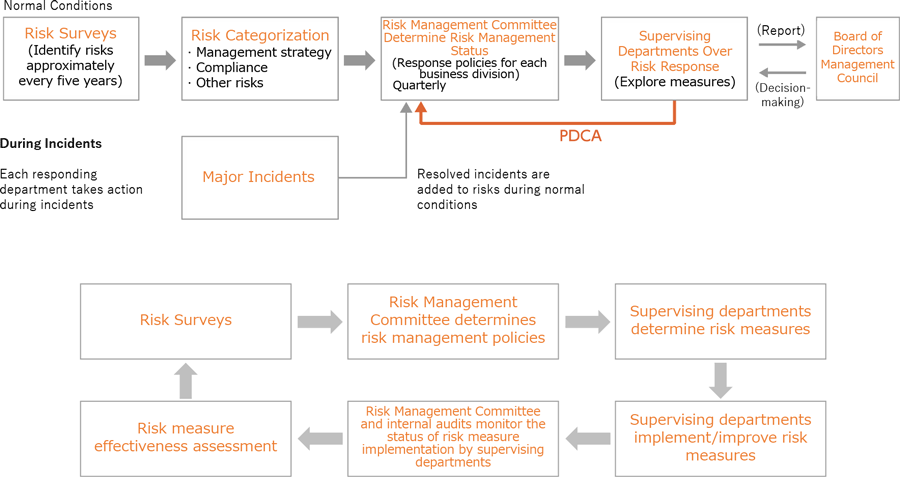
As part of future reforms in internal operations, AEON has formulated various strategies as critical areas for improvement. To achieve growth initiatives in terms of customer base and product portfolio, a proposal has been made to formulate a future vision that addresses management issues (Albalaki & Majeed, 2018). These issues primarily focus on achieving overseas business growth and accelerating mall openings, maximizing the value of brick-and-mortar malls through enhanced customer experiences, building future-generation malls while pursuing urban shopping businesses, and driving digital transformation. The company’s To-Be diagram is shown in Figure 3.
Plan for The Implementation of New Processes
AEON is exploring various technology solutions to compete and outperform other companies in the same sector. Customers prefer newer technical innovations in marketing to more traditional ones. Although everyone agreed to these terms when accepting the program’s conditions, some customers later realized that the digital techniques used could compromise their privacy (Nyagadza, 2020). AEON claims that this is the only way to ensure the accuracy of the process and provide customers with more refined and relevant content from a marketing perspective. Several companies have reduced their investment in internet advertising, leading many advertisers to believe.
AEON believes giving users control over their data and the material they share, including opt-out options, is the best practical way to address this issue. While the ability to share and like material is excellent, the ability to update feeds provides the answer. Current technological advances affect how AEON works (Hirogaki, 2021).
Since most marketing and promotion of goods and services are online, AEON must consider several strategies to reach its target market. The improvements outlined above consider the expectations and needs of the target market, ensuring that users are perceived as human beings (Nyagadza, 2020). Now, AEON aims to utilize technology to fulfill everyone’s wishes, despite the challenges of doing so individually.
Resources For Implementing New Processes
AEON’s development methodology should combine marketing tactics, social mindset, and technology to achieve its goals. For example, retail giants consider their customers’ social, economic, and cultural issues before introducing technical innovations (Cuong, 2019). The monetary aspect is part of financial considerations.
For example, AEON performs a cost-benefit analysis when selling its goods online to determine whether the costs of specific products are unreasonable or not. It integrates processes and ensures that customers are considered at every stage of the process. Ensuring that AEON does not sell to the wrong population (Hirogalki, 2021).
Demographic and other variables that affect digital marketing targets are also included in the social component. Market research indicates that different age groups of users respond to distinct ads. Although some products benefit the target audience, this is still true. Since they fully meet the company’s target group requirements, the adjustments made can be described as integrative and inclusive.
Performance Model and Management of Change
A balanced scorecard has been designed to measure the company’s performance in the post-implementation stage of the recommended strategies. The scorecard has addressed four critical perspectives: financial, internal business process, customer, and learning and growth perspectives (Bartosik-Purgat, 2019). From every perspective of the balanced scorecard, both financial and non-financial measurements are undertaken to ensure the firm achieves its desired goals. The balanced scorecard of AEON company is shown in Figure 4.

Financial Perspective
The current business operations indicate slow profit growth and declining revenues from company sales. Therefore, when the expected strategies are implemented within the firm, there will be an increase in cash flow operations in the following years, an increase in company operating income, improved sales performance, and a rise in return on equity.
Customer Perspective
Implementing the new process and other strategies will likely improve EON’s customer value. Specifically, the company would see an improved percentage of sales from the new products, efficient delivery times of the commodities to customers, and improved service lead times. Additionally, there would be adequate access to customers and the available commodities.
Internal Business Process
Implementing these changes within the firm would enhance customer satisfaction and increase the value of the services offered. The strategies ensure declining unit costs, reduced cycle times, improved yields, and a reduced error rate for the commodities. Establishing internal business processes also enhances service delivery and improves the commodities’ exposure to the industry.
Learning and Growth Perspective
Implementing the recommended strategies ensures continuous improvement and innovation in business management. Specifically, the company is likely to enhance its employees’ engagement and retention rates among customers, as well as improve the skills of its staff. Additionally, these changes ensure the effectiveness of customer relations and accessibility to business operations.
References
Albalaki, F., & Majeed, R. (2018). Customer profitability analysis, cost system purposes and decision-making process: A research framework. Account and Financial Management Journal, 3(5), 1547-1552. Web.
Bartosik-Purgat, M. (2019). Digital marketing communication from the perspective of individual consumers: a cross-country comparison. Entrepreneurial Business and Economics Review, 7(3), 205-220. Web.
Cuong, P. H. (2019). Role of digital marketing in consumer goods retailing. Evidence from Vietnam in the context of the fourth industrial revolution. Journal of Advanced Research & Economics, p. 10, 1266. Web.
Hirogalki, M. (2021). Online consumer behaviors trigger drastic distribution changes: the case of Japan. In Impact of Globalization and Advanced Technologies on Online Business Models (pp. 303–321). IGI Global. Web.
Dias, L., & Lerapetritou, M. (2017). From Process Control to Supply Chain Management: An Overview of Integrated Decision Making Strategies. Computers & Chemical Engineering, 106, 826-835. Web.
Jamshidi, D., & Rousta, A. (2021). Brand commitment role in the relationship between brand loyalty and brand satisfaction: phone industry in Malaysia. Journal of Promotion Management, 27(1), 151–176. Web.
Moore, K. (2019). Understanding Aspirational Culture—Its Foundations and Development. In Wellbeing and Aspirational Culture (pp. 31–69). Palgrave Macmillan, Cham. Web.
Nyagadza, B. (2020). Search engine marketing and social media marketing predictive trends. Journal of Digital Media & Policy. Web.
Ryan, B. J., Coppola, D., Canyon, D. V., Brickhouse, M., & Swinton, R. (2020). COVID-19 community stabilization and sustainability framework: an integration of the Maslow hierarchy of needs and social determinants of health. Disaster medicine and public health preparedness, 14(5), 623–629. Web.
Scott, P., Scott, T., Stokes, P., Moore, N., Smith, S. M., Rowland, C., & Ward, T. (2017). The consumer journey in the digital age-the challenges faced by destination and place marketing agencies. International Journal of Digital Culture and Electronic Tourism, 2(1), 28–45. Web.
Srinivasan, N., & Eden, L. (2021). Going digital multinationals: Navigating economic and social imperatives in a post-pandemic world. Journal of International Business Policy, 4(2), 228-243. Web.
Wang, F., & Ghauri, P. (2020). Partnerships in cross-cultural marketing and retail internationalization: research propositions. In Handbook on Cross-Cultural Marketing. Edward Elgar Publishing. Web.
Yang, M., Fu, M., & Zihan, Z. (2021). The adoption of digital technologies in supply chains: drivers, process and impact. Technological Forecasting and Social Change. Web.