Increase in Money Supply
The basis of monetary policy is the Federal Reserve’s open-market operations. By buying and selling these government assets, the Fed directly impacts the amount of money in circulation. According to Benita et al. (2021), the money supply increases when the Federal Reserve purchases securities.
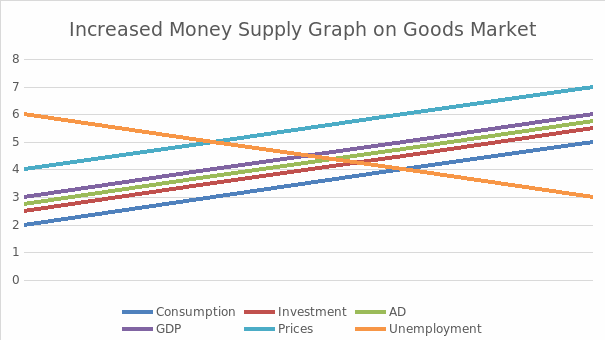
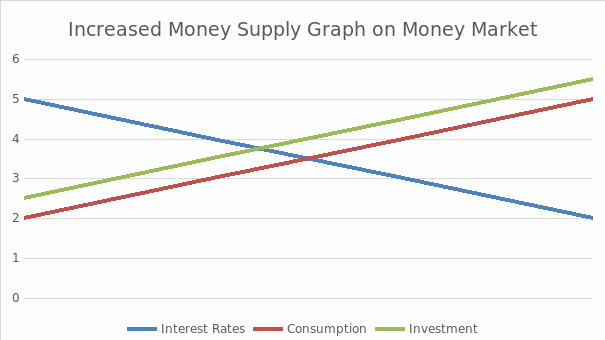
Alternatively, less money is in circulation when it sells securities. This activity alters the equilibrium interest rate in the economy. As a result of rising demand and falling yields driven by the Fed’s purchases of securities, prices rise (Appendix A). Since reduced returns lead to lower interest rates, they encourage borrowing and spending. Interest rates promote investment and consumption, which boosts the economy.
Another weapon in the Fed’s arsenal is the interest rate at which commercial banks receive Fed loans, sometimes known as the discount rate. The Federal Reserve determines this rate, which affects the quantity of loans banks must make. A lower discount rate encourages banks to borrow from the Fed because it becomes less expensive (Benati et al., 2021).
The total amount in circulation rises as more loans to enterprises and people are made available (Appendix A). The money supply decreases because people are less willing to borrow from the Fed due to an increased discount rate. A larger economy may see higher bank borrowing costs due to rising interest rates, which can discourage investment and consumption.
The reserve requirement ratio is the percentage of deposits that banks must retain as reserves. The Fed can affect the quantity of money banks lend by changing this ratio. A lower reserve requirement ratio allows banks to lend more money, increasing their money supply and loan volume (Appendix A). On the other hand, less money will be available for lending if the reserve requirement ratio increases (Benati et al., 2021). The money supply influences interest rates; typically, a lower money supply is accompanied by higher interest rates, and vice versa.
The Federal Reserve and other central banks use quantitative easing, an unconventional monetary policy tool. Government bonds and mortgage-backed securities are the long-term securities that the central bank buys in the open market as part of the quantitative easing (QE) program. Lowering long-term interest rates and promoting lending and investment are the goals of these liquidity infusions into the financial system.
Quantitative easing (QE) lowers interest rates across maturities and increases the money supply through asset purchases, facilitating borrowing and spending (Benita et al., 2021). A growing economy means that GDP and aggregate demand (AD) are rising; if demand outpaces supply, inflationary pressures may ensue (Appendix A). But over time, quantitative easing (QE) can boost employment by promoting investment and economic expansion.
Excess Reserve Policy
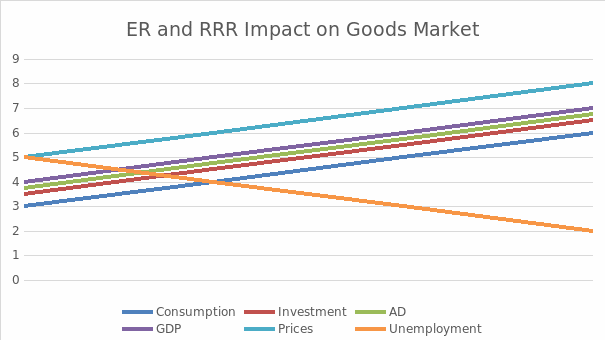
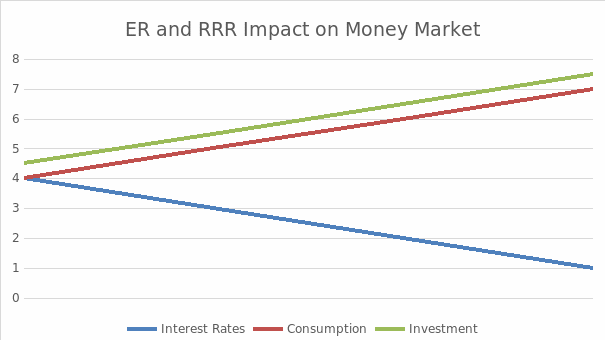
The Federal Reserve should immediately infuse a large amount of money into the banking system by lowering the reserve requirement ratio to 0.10 and increasing surplus reserves by $100 billion. More liquidity would enable banks to extend larger loans, thereby increasing the total amount of money in circulation (Benati et al., 2021). By boosting lending activity with more money, lowering the reserve requirement ratio could amplify this effect (Appendix B). This would be shown graphically as a shift to the right in the money supply curve, indicating an increase in the amount of money circulating in the economy.
Greater market liquidity for products would shift the aggregate demand curve outward, indicating higher investment and consumption. To satisfy the increased demand, businesses would raise GDP (Appendix B). However, how much of these effects occur will depend on several economic variables, such as consumers’ and businesses’ susceptibility to changes in interest rates and the state of the economy (Benati et al., 2021). To understand the implications, a thorough examination of the state of the economy is required.
Reference
Benati, L., Lucas Jr, R. E., Nicolini, J. P., & Weber, W. (2021). International evidence on long-run money demand. Journal of Monetary Economics, 117, 43-63.
Appendix A
Appendix B
ER and RRR Impact