Introduction
A key idea in finance influencing financial decisions that individuals and organizations make is the time value of money, or TVM. According to this theory, the value of money fluctuates and is not constant. It is affected by factors such as interest rates, inflation, and the risk of holding cash. For precise financial planning and investment decision-making, understanding TVM is essential.
Example of Time Value of Money
Let us start by examining the future worth of an investment of $500 at an 8% interest rate over one year. The formula used to find this future value (FV) is

Here, PV represents the initial amount (present value), r is the interest rate, and n denotes the number of periods. Applying this formula, the future value for 1 year is

Extending this to 5 years, the equation changes slightly to

Such calculations illustrate the growth of an investment through compound interest, an essential principle for both individuals and entities.
In contrast, to determine the current value of money expected in the future, the present value (PV) formula is used:

Take, for example, the current value of $500 anticipated in one year, with an 8 per cent opportunity cost. This is figured out as
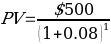
Using the same rate for 5 years, the present value calculation becomes
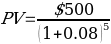
Performing these calculations provides insight into the current value of a future sum, factoring in the opportunity cost of not having the money now.
Importance of Time Value of Money
From an organizational standpoint, existing and future values significantly impact the balance sheet and budget. Understanding the time value of money helps firms make well-informed decisions about debt and long-term investments. For illustration, when a business chooses to invest in a project or buy an asset, it must consider its present cost and potential future value. The present value of future repayments must also be considered when a business takes on debt.
The concepts of TVM directly affect the balance sheet, which shows an organization’s financial position at a given point in time. According to Gapenski and Reiter (2016), this viewpoint is essential in healthcare finance since long-term asset management and liability assessment require careful consideration of TVM. Accurate valuation of assets and liabilities must consider their current and future worth. Long-term investments, for example, are usually reported at present value, which recognizes the future value adjusted for the time value of money.
Moreover, TVM has a substantial impact on the budgeting process. Present value must be considered when making plans for future income or expenses. This strategy is critical for controlling financial risks, primarily when payments are distributed irregularly, as Slobodnyak and Sidorov (2022) explain. This is particularly crucial because future cash flows must be discounted back to their current value for multi-year projects or investments. In addition to helping build a more precise and realistic budget, this strategy ensures the company neither underestimates future spending nor overestimates future income.
Conclusion
In conclusion, understanding the time value of money is crucial in finance. It significantly affects financial decision-making at the individual and organizational levels. Ultimately, more robust financial health and stability can result from entities making better-informed decisions regarding investments, budgeting, and financial planning by comprehending and putting TVM’s concepts into practice. TVM concepts are applied to real-world financial problems, as demonstrated by the computation of present and future values.
References
Gapenski, L. C., & Reiter, K. L. (2016). Healthcare finance: An introduction to accounting & financial management. Health Administration Press.
Slobodnyak, I., & Sidorov, A. (2022). Time value of money application for the asymmetric distribution of payments and facts of economic life. Journal of Risk and Financial Management, 15(12), 573.