Unemployment Rate
March 2019 unemployment statistical data is included in this summary. According to the Employment Situation Summary, as of last month, 3.8% of the working population was unemployed (U.S. Bureau of Labor Statistics, 2023a). The rate in March was the same as in February, coming in at 3.8%(U.S. Bureau of Labor Statistics, 2023a). There was a significant gain of 196,000 in nonfarm payroll jobs.
The unemployment rates of various demographics were also analyzed for this report. As of last month, March, the highest jobless rate among young people was 12.8 %. The rate was 3.6% for adult males, 3.4% for whites, and 3.3% for adult females; the rate was 6.7% for blacks. There was a 3% rate among Asians and 4.7% among Hispanics. (U.S. Bureau of Labor Statistics, 2023a).
There were not a lot of shifts in the rates from February’s numbers. The difference between February and March data is displayed in the table below.
Table 1: The difference between February and March
It could be challenging to get an accurate unemployment rate. The first stage in arriving at the rate is counting the number of people who meet the criteria for employment. Workers with low levels of commitment to their jobs and those who are actively disengaged are not reflected in the rate. They are excluded from published unemployment figures.
There is no distinction between full-time and part-time workers in the official rates. When calculating these rates, only the fact that a person is working is considered; no consideration is given to the kind of work they are doing. Whether or not workers are being underpaid is not a consideration in the rates. This indicates that underemployment is not taken into account when calculating the rates.
The repercussions of unemployment on the economy are widespread. When the unemployment rate is high, the entire population is less productive than usual. That implies the government must increase its borrowing to keep its enterprises afloat.
As more and more people lose their jobs or fail to find new ones, the country’s purchasing power as a whole decreases. The country’s gross domestic product also suffers when unemployment is high, and because of this, incomes and productivity are lower than usual. This will inevitably result in lowering spending, which in turn will reduce GDP.
Economic and social costs are associated with unemployment (U.S. Bureau of Labor Statistics, 2023a). The risk of becoming homeless is a consequence. Unemployed people have also been found to suffer from higher rates of stress, depression, and physical illness than the working population at large.
The absence of revenue caused by the unemployed person’s job impacts the person and their dependents. The rise in crime and other social ills also impacts the local community. Therefore, the government will feel the effects since it will need to increase borrowing to keep up with population needs.
The Inflation Rate
The Consumer Price Index, or the inflation rate, for March 2019 is shown below. The Consumer Price Index was 254.148. Compared to February, the index rose 0.4% in March. When February ended, the index had risen by 0.2% (U.S. Bureau of Labor Statistics, 2023b). This indicates that inflation picked up speed from February to March, rising from 0.2% to 0.4%.
In this last month, food and energy prices rose the most. The greatest percentage gain was 3.5%, which was shown in the energy index. That was responsible for over a sixth of the total rise after adjusting for seasonality.
Fuel prices and power rates rose dramatically, while natural gas fell. March saw a 6.5% increase in gasoline prices compared to the 1.5% increase in February (U.S. Bureau of Labor Statistics, 2023b). During that period, the electricity index rose at a pace of 0.4%. Electricity prices have been trending downward since January. The price of natural gas fell by 0.1% in March, as measured by the index (U.S. Bureau of Labor Statistics, 2023b). Despite March’s growth, the index is down 0.4% from a year ago due to falling energy prices.
Food prices increased in March by 0.3% month over month. The growth rate was 0.4% in February. An increase of 1.6% was seen in the index for fruit and vegetable prices. Both fresh fruit sales and vegetable sales went up by 1.2% and 2.0%, respectively (U.S. Bureau of Labor Statistics, 2023b). The bakery goods and cereals index rose by 0.3%, while dairy and allied items rose by 0.6%. February saw a rise of 0.4% over the previous month.
Compared to other industries, the apparel industry experienced the lowest inflation rate (-1.9%) (U.S. Bureau of Labor Statistics, 2023b). As a result, clothing is now readily available at rock-bottom prices. There was also a marginal contribution from the sale of used automobiles and commercial trucks to the overall increase in the index. As March ended, they were down 0.4% (U.S. Bureau of Labor Statistics, 2023b). The value of commodities, excluding energy and food, fell by 0.2% as well.
In general, commodity prices rise in tandem with inflation. When inflation rates rise, consumers’ ability to buy goods and services is diminished. Rising costs without corresponding increases in people’s disposable income mean consumers must settle for smaller purchases. When inflation occurs, creditors are one group of victims (GovInfo, n.d.).
Due to the decline in the currency’s value, the repaid loan amount will be less than the original loan amount. The value of savings will decrease for savers because of the change in interest rates. The holders of fixed salaries are another vulnerable demographic to inflation. The increased cost of living will force people to spend less money overall. This could leave them with fewer or even zero savings.
According to the data presented, the cost of living has increased, particularly in regard to food, which will negatively impact consumer spending. Inflation needs to be contained so that people have plenty of money to spend. Despite a drop in the price of natural gas, the cost of energy has increased (GovInfo, n.d.). The inflation rate should be monitored to ensure the country’s economic stability.
Unemployment Data by Labor Force Groups and Duration
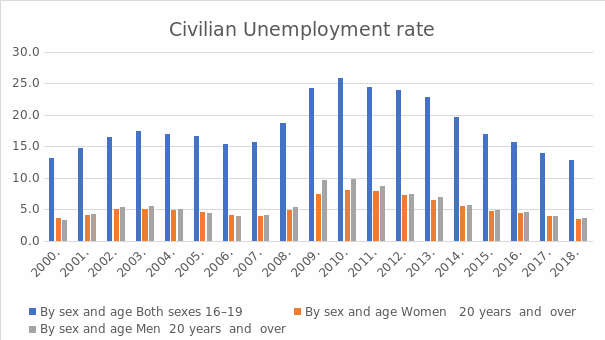
There are different unemployment rates for various demographics. In 2010, the unemployment rate for people between 16 and 19 was 25.9% for both sexes. Male and female workers aged 20 and up experienced their highest unemployment rates ever in 2010 (U.S. Bureau of Labor Statistics, 2023c). Among people aged 16–19, 2018 recorded the lowest percentage at 12.9%.
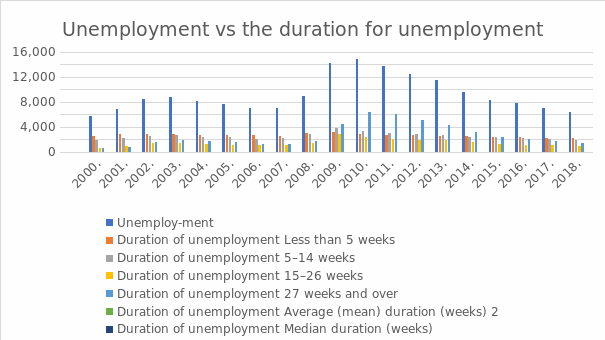
In 2018, the lowest rate was among women aged 20 and over. Men aged 20 and up had the lowest rate (3.3% in 2000) of any age group (U.S. Bureau of Labor Statistics, 2023c). With an average of 39.4 weeks, 2012 was the longest period of unemployment on record.
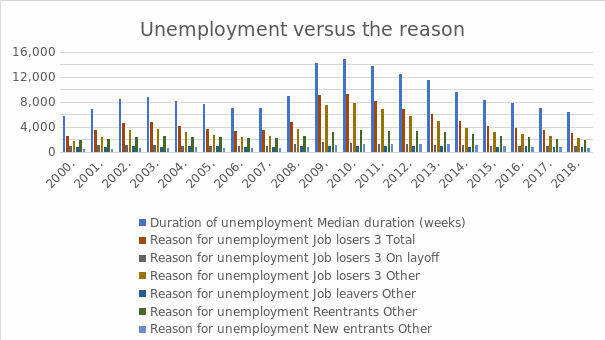
Unemployment data can also be broken down by cause. The most significant number of people laid off in a given year was 1,630,000 in 2009, while the lowest was 852,000 in 2018 (U.S. Bureau of Labor Statistics, 2023c). In light of projected future population growth, it is clear that minority and youth unemployment rates will rise. High unemployment rates in 2010 were a direct outcome of the Great Depression that began in the years leading up to that year. However, the unemployment rate is highest among the young, between the ages of 16 and 19.
References
GovInfo. (n.d.). Economic Report of the President. Web.
U.S. Bureau of Labor Statistics. (2023a). Employment situation summary – 2023 M01 results. U.S. Bureau of Labor Statistics. Web.
U.S. Bureau of Labor Statistics. (2023b). Table 2. consumer price index for all urban consumers (CPI-U): U. S. city average, by detailed expenditure Category – 2022 M12 results. U.S. Bureau of Labor Statistics. Web.
U.S. Bureau of Labor Statistics. (2023c). Consumer price index summary – 2022 M12 results. U.S. Bureau of Labor Statistics. Web.