Introduction
Socially significant enterprises, such as childcare facilities, must monitor financial activity with particular seriousness, since the safety, quality of food, time, and leisure for children are essential and often require higher expenses. This paper examines an invented childcare center in Alberta, Canada, and budget management for the next two months. It is assumed that this center can accommodate a maximum of 74 children, but in the first month, 60 attend, and in the second month, their number increases to 65.
Two early childhood educators at the first level, two at the second, and one at the third level were hired for the service. In addition to five specialists, the building has an administrator who resolves all payment and registration issues with parents. The center itself offers full-time daycare services on weekdays.
Budgeting
Budget development begins with planning expenses; information was collected from open sources, taking into account the pricing factors and the specifics of the activity. The salary schedule was based on current rates for early childhood educators at various hourly levels, sourced from the labor market (Indeed, 2024). For the three levels, the government provides wage top-ups of $2.64, $5.05, and $8.62 per hour, so $4,796 will be compensated by this grant (Alberta, 2023).
The administrator’s compensation is at the level of a first-level specialist. In addition, these costs require payment of payroll taxes, set at 15% of total income, since wages do not exceed the permissible increased tax level for these employees (Government of Canada, 2024). The calculations for the first and second months resulted in additional expenses of $719 and $723, respectively. As a consequence, the general calculation for this expense item is as follows:

It is worth noting that the search for accurate rental prices for premises provided the basis for correctly assessing the size in square meters and the maximum number of children. A lease offer for a space of almost 4,000 square meters, equipped as a daycare for children, costs $678,000 for ten years, or $5,650 per month (Kijiji, 2024). Such real estate offer aggregator sites most accurately assess current market offers and prices, including rental prices. However, it is not always possible to obtain detailed, accurate information on any expense item, and this work often uses averaged information across several costs reported in the resulting budget table.
For example, estimates of food costs were based on relative indicators from official sources. According to the Alberta $10-a-day program, which reduces parents’ childcare facility expenses to this threshold, government officials emphasize that 80% of the costs of this business go to food and labor (McGinn, 2023). Background information from other small business media reports indicates a food cost of $3 per child (Frost, 2020). Considering inflation, starting in 2020, the daily price was set at $4 per child for this facility. The calculation was carried out as follows:


However, the following are also considered in addition to these budget items. First, the average utility cost for large premises is about $500 per month, approximately twice that of a typical household (Moving Waldo, 2023). Secondly, a responsible business in the childcare industry must have insurance, which averages about $3,500 per year, allowing expenses to be set at $300 per month (Insurdinary, 2022).
Finally, it is necessary to account for supplies, which may include both the purchase of new educational materials, books, and toys, and the maintenance of security measures such as cameras, alarm systems, and secure entry systems to monitor and control access to the facility. The safety aspect is critical in the context of childcare, requiring, in addition to the specified goods and services, stocking first-aid kits, bandages, antiseptic wipes, and other medical supplies to handle minor injuries and emergencies, which costs about $450 per month.
Medical safety is also implemented through a responsible attitude to the cleanliness of the premises. To achieve this goal, about $ 350 per month is spent on cleaning services, calculated based on industry-average costs and the premises’ square meters (CleanerMatch, 2024). Finally, marketing costs were set at 350 dollars, again an average estimate of distribution services across the major channels consumed by the parent target audience (Brown & Herbst, 2022). It is worth noting that as the regular customer base filled up, approaching its maximum by the second month, expenses were slightly reduced to align with the supply capabilities of up to $250.
In Canada, parents’ costs for such services are quite high, leading to the need for regulatory oversight by authorities through the programs mentioned above. The average price of a childcare facility is $7,790 per year or $649 per month (Hornstein, 2023). Since the business in question is aimed, among other things, at social responsibility and compliance with the Alberta $10 per day program, the daily price was set at $27, which is noticeably below the national average. As a result, revenue calculations for the first and second months were as follows:


Table 1 – Childcare Facility Budget
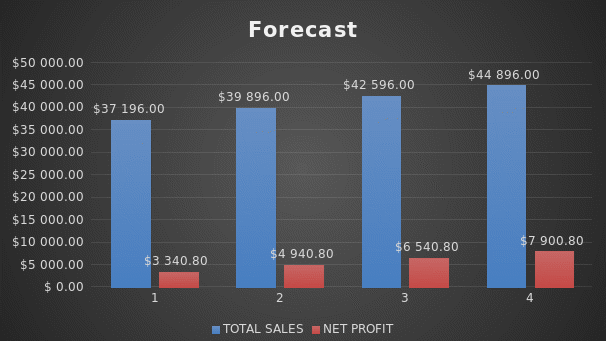
Table 1 shows that the enterprise is quite profitable; adding 5 clients increases net profit by $1,600, or almost 47%. Although food and wage costs are rising, given the fair wage policy, even the reduced prices of these services relative to the national average allow the business to grow. The potential for maximum growth, based on the client base’s current growth rate, is shown in Figure 1. It shows that the net profit margin relative to revenue increases from 9% to 17.6% with the maximum possible number of clients.
Conclusion
The conducted study aimed to determine the budget of an invented childcare facility for the next two months of operations. Cost information was obtained from public officials and similar secondary sources, as well as articles. Even at a price below the national market average, the enterprise is profitable, with a growth potential of up to 17.6% net profit margin, offering opportunities for future expansion and the opening of a new establishment under this brand.
References
Alberta. (2023). Alberta Child Care Grant Funding Program.
Brown, J. H., & Herbst, C. M. (2022). Childcare over the Business Cycle. Journal of Labor Economics, 40(S1), S429-S468.
CleanerMatch. (2024). How much does a daycare cleaning service really cost?Medium.
Frost, S. (2020). How much does it cost to run a daycare? Chron.
Government of Canada. (2024). Income tax rates for individuals.
Hornstein, J. (2023). The costs and demand for childcare in Canada. CIC News.
Indeed. (2024). Instructor, early childhood education.
Insurdinary. (2022). Daycare insurance – explained.
Kijiji. (2024). Brand New Daycare.
McGinn, D. (2023). Alberta’s childcare cost framework puts cost of feeding kids on parents. The Globe and Mail.
Moving Waldo. (2023). Alberta utility bills: How much does it cost for electricity, water, gas, internet, cable & home phones in 2024?